Understanding the Weather Class 7 Question Answer Social Science SST Chapter 2
Class 7 SST Chapter 2 Understanding the Weather Question Answer
Understanding the Weather Class 7 Questions and Answers
The Big Questions (Page 1)
Question 1.
How can we measure and monitor the weather around us?
Answer:
We can measure and monitor the weather around us by the use of natural methods and statistics of weather.
It should be kept in mind that the methods of measuring and monitoring the weather may be different for a layman and an expert. In this respect below points will help in understanding:
In view of a Layman (Common Man)
Measure the weather by observing Nature and the movements of natural animals :
- Observing the opening and closing of pine cones.
- Observing the birds flying low.
- Observing the ants carrying eggs.
- Observing the squirrels gathering nuts.
- Observing the frogs croaking loudly.
In view of Meteorologist or Scientist
Measure the weather by observing the scientific instruments:
- Using various modern gadgets like Thermometer, Hygrometer, Rain Gauge, Wind Vane, Anemometer and Barometer etc., weather data are measured.
- Measure by sensors equipped AWS (Automated Weather Station): This is a station where all types of weather data are recorded with the help of the various equipped sensors.
- Measure by the satellite and the radar help in mapping such areas.
Nowadays we can get the weather data on our phones and computer devices which are directly connected to with the satellite and give us valuable information about the weather and update us with the latest information.
Monitor:
- By collecting data on a regular basis like movements of the air and sea waves, duration of sunshine, the amount of humidity, the amount of rainfall etc.
- If the meteorologists realise a signal of bad weather, they advise the local government to mobilise resources and prepare for disaster.
By measuring and monitoring the weather around us, we can be alert and take suitable steps to protect life and follow the instructions, delivered by the meteorological departments from time to time through various means of communications like Radio, TV and other gadgets.
Question 2.
How do weather predictions help us prepare for events like heavy rains, storms, drought and heat waves?
Answer:
The weather predictions help us prepare for events like heavy rains, storms, drought and heat waves in the following manner :
Help in declaring high alert in a particular area
- Helping the government to declare an emergency like flood alert, alert for any landslide, heat waves, storms etc.
Help in evacuating the area
- Advise the local governments to mobilise resources and evacuate the area where such kinds of weather conditions are going to happen.
Help in the preparation of emergency services
- Help in the timely preparation for medical emergencies like fire-fighters, rescue teams, medical staff etc. to overcome the situation.
- Help in updating the current condition of the weather through various means of communication like TV, Radio, Apps and Social Media from time to time.
The weather prediction has become a blessing for the communities and government to take the decision timely and precisely. Such predictions in a true sense help in saving the lives and property of those particular areas.
Class 7 Social Science Chapter 2 Understanding the Weather Question Answer
LET’S EXPLORE (Page 28)
Question 1.
What are some of the words in your local language that you use to describe the weather?
Hot, cold, warm, chilly, crisp, pleasant, and so on, are commonly used terms in English.
Answer:
Somer of the words in local language for describing the weather are followings:
Hot, Cold, Warm, Chilly, Crips, Calm, Pleasant, Rainy, Cloudy, Humid, Snowy, windy, Chill, Scorching, Bad, Nice.
THINK ABOUT IT (Page 29)
Question 1.
Let us imagine that Krishnan from Chennai is speaking with Amir in Kashmir. Krishnan tells Amir that it has become chilly in Chennai after it rained the previous night. Amir asks him how cold it is. How will Krishnan explain to Amir how cold it is? After all, what is cold for Krishnan may be quite pleasant for Amir!
Answer:
It would be very difficult to convey their sense of chillness by Krishnan and Amir without measuring the temperatures.
First, we would try to know the climates (weather) of those particular regions.
Krishnan comes from Chennai: Hot apd humid region. Amir comes from Kashmir: Cold region (winter temperature goes down below freezing points)
Krishnan might explain:
I (Krishnan) felt chilly after it rained the previous night. It brought down the temperature to 23 degrees Celsius, which was 36 degree Celsius before rain but that might not be good for you in Kashmir.
LET’S EXPLORE (Page 29)
Question 1.
What do you think could be some other reasons to measure the weather more precisely?
(Hint: Think how knowing the weather a few hours or a few days in advance would help you plan some activities.)
Answer:
Some other reasons to measure the weather more precisely are following:
- By using meteorological gadgets like thermometers, hygrometers, anemometers, wind vane etc.
- By the use of satellite and the satellite related devices.
- By observing the nature and observing natural methods like birds flying low, ants carrying eggs etc.
Above-mentioned methods will indeed help to determine the weather a few hours or a few days in advance. It would assist you to make you plans for some other activities.
LET’S EXPLORE (Page 30)
Question 1.
Talk to elders in your neighbourhood and ask them how they predict the weather. What signs do they observe? Document any sayings in your regional language that refer to weather prediction.
Ans. After speaking with my neighbours, Shri Radhey Shyam Ji and Shri Ram Kumar Ji, both approximately 78 years old. They shared the following traditional methods :
Observing Bird Behaviour :
- Loud Calls : indicate impending rain.
- Flying low : suggests that rain is approaching.
Observing Ant Activity : It is a sign of forthcoming rain.
Observing Frog behaviour : Frogs croaking loudly indicate that the rain is coming.
Weather Prediction in Haryanvi language : “Kaag bole to Barsaat ki Jog”
Meaning : If a crow caws loudly during summer, it indicates the arrival of rain.
LET’S EXPLORE (Page 32)
Question 1.
Here’s a chart of the temperatures of a city in Madhya Pradesh. What is the maximum temperature recorded in the i week shown here? What is the minimum? Calculate the range.
| Date | Maximum Temperature (in degrees Celcius) | Minimum Temperature (in degrees Celcius) |
| 28.02.2025 | 29 | 16 |
| 01.03.2025 | 30 | 15 |
| 02.03.2025 | 31 | 17 |
| 03.03.2025 | 32 | 18 |
| 04.03.2025 | 30 | 18 |
| 05.03.2025 | 28 | 14 |
| 06.03.2025 | 29 | 15 |
Answer:
Maximum Temperature = 32 degrees Celcius
Minimum Temperature = 14 degrees Celcius
Range = [Maximum Temperature - Minimum Temperature]
= 32 - 14 = 18 degree Celcius
Question 2.
Remember the conversation between Krishnan and Amir? If Krishnan said it was 20°C in Chennai and he was feeling a little cold, he and Amir would have a measure they could understand. What do you think Amir’s reaction to Krishnan’s statement might be?
Answer:
“Yes, the conversation between Krishnan and Amir was based on varying temperatures of two regions.
Amir’s reaction to Krishnan’s statement
Amir is based in a cooler region and finds comfortable, while Krishnan, used to heat, feels cold.
LET’S EXPLORE (Page 34)
Question 1.
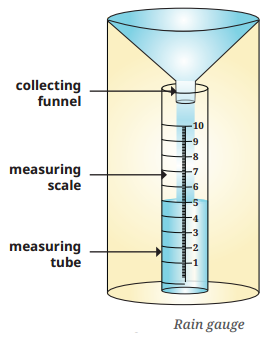
Make a rain gauge as shown in the diagram above. Place the rain gauge in an open area, away from objects that might obstruct rain. Ensure that the rain gauge is on a the surface and will not tilt or topple with the wind. Using the measuring scale, record the amount of rainwater collected at the same time every day, for a month. (If there is snow, allow it to melt before taking the measurement.) Calculate the average rainfall for every week in that month and comment on the variation from week to week.
Answer:
Construct a rain gauge in your laboratory, as shown in the image, with the assistance of your teacher :
Methods to calculate Average Weekly Rainfall:
- Ensure that the gauge is placed correctly to accurately collect the rainfall.
- Record the amount of rainfall each day in millimetres as indicated by the rain gauge.
- If there is no rainfall on a particular day, record “0 mm”
- Add the daily rainfall amounts for the week to obtain total weekly rainfall and divide the total by 7 to find the average for the week.
For Example :
Week 1: 0 mm, 1 mm, 2 mm, 5 mm, 0 mm, 0 mm, 10 mm
Total weekly rainfall: 0 + 1 + 2 + 5 + 0 + 0 + 10 = 18 mm
Average Daily Rainfall: 18 mm/7 = 2.57 mm
Week 2: 0 mm, 0 mm, 0 mm, 0 mm. 1 mm. 2 mm, 1 mm
Total weekly rainfall: 0 + 0 + 0 + 0 + 1 + 2 + 1 = 4mm
Average Daily Rainfall: 4mm / 7 = 0.57 mm
Week 3: 0 mm, 0 mm, 0 mm, 0 mm, 0 mm, 0 mm, 0 mm
Total weekly rainfall: 0 + 0 + 0 + 0 + 0 + 0 + 0 = 0 mm
Average Daily Rainfall: 0 mm / 7 = 0
Comment on variation from week to week :
- Week 1 experienced the highest, totalling 18 mm, indicating a wetter period.
- Week 2 shows significantly less rainfall with only 4mm.
- Week 3 had no rainfall at all.
These variations can be attributed to factors such as the physiography of the region and seasonal or monsoonal climate patterns.
THINK ABOUT IT (Page 35)
Question 1.
Why do you think it would be important to measure atmospheric pressure? Who are the people most likely to use such measurements?
Answer:
I think it would be important to measure atmospheric pressure due to following reasons:
- For forecasting the weather.
- To ensure the safety of movements of flights and navigations.
- For ensuring the safety of life and property.
- For scientific research.
Responsible People to use such measurement
- Majorly in precise manner
- Meteorologists, Environmental Scientists etc.
Question 2.
People who journey to places at a high altitude are advised to make pauses on the way to allow the body to acclimatise. Our army personnel serve in high- altitude places like Khardung la in Ladakh, which is over 5600 metres above sea level. It is hard to imagine how they live and work in places where the oxygen level is so low — the atmospheric pressure there is generally about 650 millibars!

Answer:
People who journey to places at a high altitude are advised to make pause on the way to allow the body to acclimatise in the light of the following 2 major reasons :
- Physical Challenges
- Life-threatening risks, headaches, nausea etc.
- Environmental Challenges
- Harsh weather conditions like low atmospheric pressure, low level of oxygen etc.
THINK ABOUT IT (Page 36)
Question 1.
Have you seen seeds like these flying in the wind? What would happen to the seeds if there was no wind?

Answer:
Yes, I have seen seeds like these flying in the wind. If there was no wind, the following things happened to the seeds:
- Survival of plants become very difficult
- The same species of the plants can’t be noticed anywhere.
- If the species existed in the same place, the competition among them would increase and in the end, the result would be almost extinction.
LET’S EXPLORE (Page 37)
Question 1.
Where do you think humidity is likely to be more, Kochi or Jaipur? You might guess that Kochi has higher humidity than Jaipur because it is located near the sea. But how will we know for sure? If we had to compare the humidity level between Kochi and Mangaluru, how would we do it? Discuss with your classmates.
Answer:
Obviously in Kochi.
We can confirm it from the following points :
- With the help of weather data, using weather apps, and using data released from IMD.
- By analysing the patterns that show higher and lower humidity levels.
- By noticing the seasonal and climatic changes in summer and winter.
Both Kochi and Mangaluru are coastal cities. The humidity level between them might be similar.
Comparing it in the following ways :
- Check daily humidity from various sources like IMD and weather.com.
- Record morning and evening humidity over a week or a month.
- Share findings in the group and compare which had the highest average humidity.
- It is because of elevation, closeness of the sea, etc.
THINK ABOUT IT (Page 38)
Question 1.
If the humidity in Delhi is at 52% while in Kochi it is 84%, in which of the two places are wet clothes likely to dry faster? And where are you likely to sweat more, assuming the temperature is the same in both places?
Answer:
Case-I
Humidity of Delhi- 52%
Humidity of Kochi-84%
Wet clothes of Delhi is likely to dry faster.
Case-II
If the temperature is the same in both places, the people of Kochi experience more sweating because of high humidity.
LET’S EXPLORE (Page 41)
Question 1.
Discuss, in pairs, different situations in which weather predictions are helpful. Make a list, and after you have completed it, share it and discuss it with the pair sitting next to you. How many different categories of situations have you been able to identify?
Answer:
| Category | Situations For Helpful Weather Predictions |
| 1. Planning for excursion | Help in finding the safe route. Help in packing the clothing according to the situatins. |
| 2. Agricultural activities | Help in deciding the growing periods and harvesting periods. Aler from harmful climate. |
| 3. Disaster | Help in saving life and property. |
Question 2.
What do you observe happening on that day? What are the various weather . conditions that the IMD is alerting people to?
Answer:
Do yourself.
The various weather conditions that the IMD is alerting people to are the following:
- Alert to the people about the changes in weather like heavy rainfall, lightning, heat, cold waves etc.
- Alert about the degree of calamity- like high level of risk and nominal risk.
- Inform about the expected effects like power issue, flooding, crop failure etc.
Question 3.
Which states have warning signs?
Answer:
If you look at the following map, you can find the names of states having warning signs.
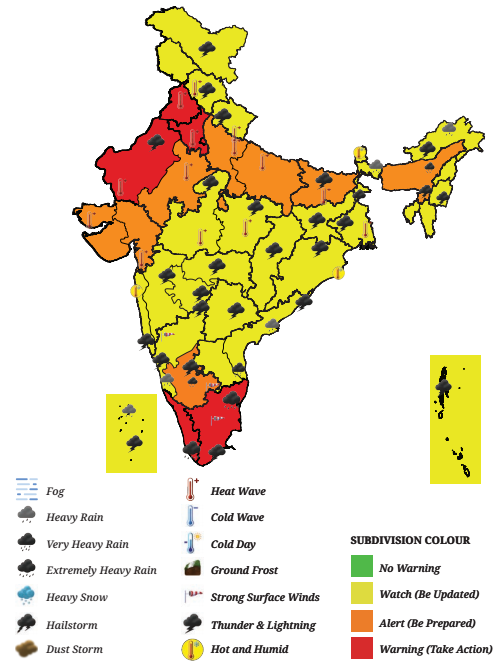
- Punjab
- Haryana
- Rajasthan
- Tamil Nadu
Question 4.
Which parts of India are likely to be free from severe weather?
Answer:
According to the given map, No part of India is entirely free from severe weather
Question 5.
Which states are likely to face heat wave conditions?
Answer:
States are likely to face heat wave conditions are followings:
Rajasthan, Haryana, Punjab, Gujarat, Uttar Pradesh, Madhya Pradesh, West Bengal etc.
Question 6.
What are the causes for warning in Tripura and Lakshadweep?
Answer:
The causes for warning in Tripura and Lakshadweep are as follows:
Causes for warning in Tripura:
- Due to urbanisation.
- Due to Industrialisation.
- Due to the increase in number of motor vehicles.
- Due to change in weather patterns
Causes for warning in Lakshadweep:
- Due to the rise in temperature of the sea.
- Due to change in ocean currents.
Class 7 Understanding the Weather Question Answer
Questions and Activities (Page 42-43)
Question 1.
Match the instrument with the weather element it measures.
| Instrument used | Element of the Weather |
| (1) Hygrometer | (a) Precipitation |
| (2) Anemometer | (b) Atmospheric pressure |
| (3) Barometer | (c) Wind direction and speed |
| (4) Thermometer | (d) Humidity |
| (5) Rain gauge | (e) Temperature |
Answer:
1. (d)
2. (c)
3. (b)
4. (e)
5. (a)
Question 2.
Jvotsna is deciding what clothes to pack for her school trip to Mumbai in June. She looks at the weather forecast, which predicts 29°C and 84% humidity. What would be your advice to her?
Answer:
According to the weather information given in the question, my advice to Jyotsna is to pack the following items with her during her School trip to Mumbai in the month of June:
- Light and loose clothes
- Comfortable footwear like sandals and waterproof shoes.
- Light shawl or jacket in case of cooling in the evening.
- Medication kit
Question 3.
Imagine that a small group of students is setting up a rain gauge.
Here are some options for the site.
- The school vegetable garden.
- The terrace of the school building.
- Open ground with elevated platform.
- Compound wall of school.
- Verandah of the school laboratory.
Discuss in your group and finalise the site. Write down the reasons for your decision.
Answer:
The site is finalised to set up a rain gauge- “Open ground with elevated platform”.
Reasons for my decision
- The selected option is good and safe.
- The selected option ensures precise measurement of rainfall.
- The selected options avoids disturbances like splashing water etc.
Question 4.
Below is a chart taken from IMD, Jammu and Kashmir. Looking at the data available, write a short script to report the weather conditions in different parts of Jammu and Kashmir on the date shown. (Hint: Cover the temperature range, maximum and minimum temperatures, humidity, precipitation, etc.)
Daily Weather Parameters
Jammu & Kashmir (EVENING)
DATE: 01-02-2024
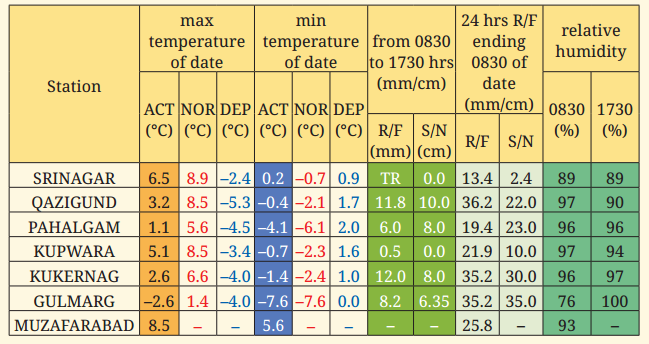
Note: ACT means actual: NOR means normal: DEP is departure from normal: R/F is rainfall; S/N is snowfall; TR means trace amount.
Answer:
Range of temperature :
| STATION | RANGE OF TEMPERTURE Range = (Max Temp - Min. Temp) |
| Srinagar | 6.3 = {6.5 - (0.2)} |
| Qazigund | 3.6 = {3.2 - (-0.4)} |
| Pahalgam | 5.2 = {1.1 - (-4.1)} |
| Kupwara | 5.8 = {5.1 - (-2.3)} |
| Kukernag | 4 = {2.6 - (-1.4)} |
| Gulmarg | 5 = {-2.6 - (-7.6)} |
| Muzafarabad | 2.9 = {8.5-(5.6)} |
Relative Humidity:
| STATION | Average Relative Humidity = RH (%) for 0830 + RH for 1730/2 |
| Srinagar | 89 |
| Qazigund | 93.5 |
| Pahalgam | 96 |
| Kupwara | 95.5 |
| Kukernag | 96.5 |
| Gulmarg | 88 |
| Muzafarabad | 46.5 |
Precipitation:
| STATION | Total Precipitation TP = RF + SN |
| Srinagar | NA |
| Qazigund | 111.8= 11.8 + 10 × 10 |
| Pahalgam | 86 = 6 + 8 × 10 |
| Kupwara | 0.5 = 0.5 + 0 × 10 |
| Kukernag | 92 = 12 + 8 × 10 |
| Gulmarg | 71.1 = 8.2 + 6.35 × 10 |
| Muzafarabad | 0 = 0 + 0 × 10 |
Exploring Society India and Beyond Class 7 Solutions
More from Class 7
- Banks and the Magic of Finance Class 7 Extra Questions and Answers SST Part 2 Chapter 8
- Infrastructure: Engine of India’s Development Class 7 Extra Questions and Answers SST Part 2 Chapter 7
- The State, the Government, and You Class 7 Extra Questions and Answers SST Part 2 Chapter 6
- India, a Home to Many Class 7 Extra Questions and Answers SST Part 2 Chapter 5
- Turning Tides: 11th and 12th Centuries Class 7 Extra Questions and Answers SST Part 2 Chapter 4
- Empires and Kingdoms: 6th to 10th Centuries Class 7 Extra Questions and Answers SST Part 2 Chapter 3
More in Social Science
- Banks and the Magic of Finance Class 7 Extra Questions and Answers SST Part 2 Chapter 8
- Infrastructure: Engine of India’s Development Class 7 Extra Questions and Answers SST Part 2 Chapter 7
- The State, the Government, and You Class 7 Extra Questions and Answers SST Part 2 Chapter 6
- India, a Home to Many Class 7 Extra Questions and Answers SST Part 2 Chapter 5
- Turning Tides: 11th and 12th Centuries Class 7 Extra Questions and Answers SST Part 2 Chapter 4
- Empires and Kingdoms: 6th to 10th Centuries Class 7 Extra Questions and Answers SST Part 2 Chapter 3