India and Her Neighbours Class 7 Extra Questions and Answers SST Part 2 Chapter 2
India and Her Neighbours Class 7 Extra Question Answer
Question 1.
What cultural influences does the Maldives show from India?
Answer:
The Maldives shows influences from Tamil Nadu and Kerala in language, cuisine, and arts. Dishes like coconut curries reflect South Indian flavours, and Boduberu dance echoes Tamil folk rhythms.
Question 2.
What is the India-Myanmar-Thailand Trilateral Highway?
Answer:
The India-Myanmar-Thailand Trilateral Highway stretches from Manipur through Myanmar into Thailand. It improves overland connectivity, trade, and regional cooperation amongst the three countries.
Question 3.
What is the Borobudur Stupa?
Answer:
The Borobudur Stupa is the world’s largest Buddhist monument, built in stone in the 8th and 9th centuries CE in Indonesia. It has over 500 Buddha statues.
India and Her Neighbours Class 7 Very Short Question Answer
Question 4.
What is Cliabahar Port, and why is it important for India?
Answer:
Chabahar Port is located in Iran, and India is helping develop it. This port gives India better access to Afghanistan and Central Asia for trade and transport.
Question 5.
How are India and Oman historically connected?
Answer:
People-to-people contact between India and Oman dates back over 5,000 years to the time of the Indus or Harappan civilisation. Harappan traders brought back copper ingots from Oman.
Question 6.
Which Indian states share a border with Bangladesh?
Answer:
The Indian states that share a border with Bangladesh are West Bengal, Assam, Meghalaya, Tripura, and Mizoram. This border is longer than India’s border with China.
Extra Questions of India and Her Neighbours Class 7
Question 7.
What is the Sundarban National Park, and where is it located?
Answer:
The Sundarban National Park is the largest mangrove forest in the world and a UNESCO World Heritage Site. About two-thirds lies in Bangladesh and the rest in India.
Question 8.
What does the 1950 Treaty of Peace and Friendship with Nepal provide?
Answer:
The 1950 Treaty provides for open borders and free movement of people and goods between India and Nepal. It also includes cooperation in defence and foreign policy.
Question 9.
Why is Bhutan called the ‘Land of the Thunder Dragon’?
Answer:
Bhutan is called ‘Drukyul’ or ‘Land of the Thunder Dragon’ by its inhabitants. The dragon on Bhutan’s emblem symbolises the thunderous voice of the Buddha’s teachings.
Question 10.
What is the Gross National Happiness Index?
Answer:
Bhutan developed the Gross National Happiness Index as a more holistic measure of progress compared to Gross Domestic Product. It includes sustainability, good governance, and promotion of culture.
Question 11.
Which countries are India’s land-based neighbours?
Answer:
India’s land-based neighbours are Pakistan, Afghanistan, China (Tibet region), Nepal, Bhutan, Bangladesh, and Myanmar. These countries share direct land boundaries with India.
Question 12.
What is the total length of India’s land borders?
Answer:
India’s land borders stretch over 15,100 kilometres. These borders pass through deserts, plains, forests, mountains, marshes, and river valleys across different geographical features.
Question 13.
What is the length of India’s coastline?
Answer:
India has a long coastline of about 11,100 kilometres along three sides of the country. This gives India a strong maritime position in the region.
Question 14.
Name three maritime neighbours of India.
Answer:
Three of India’s maritime neighbours are Sri Lanka, the Maldives, and Indonesia. These countries are connected to India by shared seas or oceans without direct land borders.
Question 15.
Which Indian states share a border with China?
Answer:
The Indian states that share a border with China are Arunachal Pradesh, Sikkim, Uttarakhand, Himachal Pradesh, and Ladakh. The border runs across the Himalayas.
Question 16.
Which Indian states share a border with Myanmar?
Answer:
India’s northeastern states that share borders with Myanmar are Arunachal Pradesh, . Nagaland, Manipur, and Mizoram. Myanmar also shares a maritime boundary with India in the Bay of Bengal.
Question 17.
What was the ancient Uttarapatha trade route?
Answer:
The Uttarapatha was an ancient trade route linking the Ganga plains to Central Asia via Afghanistan. It stretched from Gandhara through Takshashila, Varanasi, and Pataliputra.
Question 18.
What were the Buddhas of Bamiyan?
Answer:
The Buddhas of Bamiyan were gigantic statues in Afghanistan and symbols of Mahayana Buddhism. They were destroyed in 2001 after standing for many centuries.
Question 19.
When was SAARC formed, and what are its aims?
Answer:
The South Asian Association for Regional Cooperation (SAARC) was formed in 1985 to promote mutual interests and sociocultural and economic progress. It aims to share resources around development.
Question 20.
What does India export to China?
Answer:
India exports iron ore, chemicals, and cotton yarn to China. In return, India imports electronics and industrial equipment from China for its industries.
India and Her Neighbours Class 7 Short Question Answer
Question 1.
Explain the significance of India’s location in the Indian Ocean for regional cooperation and trade.
Answer:
India’s central position in the Indian Ocean provides strategic advantages for trade and regional cooperation. Its peninsular location extends deep into the ocean, offering access to major sea routes connecting Southeast Asia, West Asia, and Africa. Indian ports serve as vital gateways for imports and exports. This location facilitates quick humanitarian aid and disaster relief operations, promoting regionalism, peace, and stability.
Question 2.
Describe the cultural connections between India and China, particularly through Buddhism.
Answer:
India and China share profound cultural connections through Buddhism, winch spread from India to China around the 1st century CE via trade and pilgrimage routes. Chinese monks like Faxian and Xuanzang travelled to India to study Buddhist teachings. Indian monks such as Bodhidharma, Dharmakshema, and Kumarajlva carried Buddhist philosophy to China, creating lasting spiritual bonds despite being separated by the Himalayas.
Question 3.
What is the Sundarbans National Park and why is it important for both India and Bangladesh?
Answer:
The Sundarbans National Park is a UNESCO World Heritage Site and the world’s largest mangrove forest, shared between India and Bangladesh. Approximately two-thirds lies in Bangladesh whilst the remainder is in India. This unique ecosystem is home to the Bengal tiger and numerous other species. The mangrove forest serves as a natural barrier against cyclones, protecting millions of coastal inhabitants from natural disasters.
Question 4.
Explain how the 1950 Treaty of Peace and Friendship benefits India and Nepal.
Answer:
The 1950 Treaty of Peace and Friendship between India and Nepal establishes open borders allowing free movement of people and goods without requiring visas or passports. This arrangement enables families to maintain connections and facilitates easy movement for work, education, trade, and religious visits. The treaty also provides for cooperation in defence and foreign policy, recognising deep cultural and economic ties.
Question 5.
What was the historical significance of the Uttarapatha trade route for India and Afghanistan?
Answer:
The Uttarapatha was an ancient trade route connecting the Ganga plains to Central Asia through Afghanistan. It stretched from Gandhara (modern Kandahar) through Takshashila, Varanasi, and Pataliputra. This vital commercial corridor enabled extensive cultural exchange, facilitating the spread of Buddhism, Hinduism, art, and philosophy. Before Islam’s arrival, Afghanistan was a centre of Buddhist and Hindu culture with kingdoms mirroring Indian systems.
Question 6.
What types of neighbours does India have, and which countries fall under each category?
Answer:
India has two types of neighbours: land- based and maritime. Land-based neighbours share a land boundary with India and include Pakistan, Afghanistan, China, Nepal, Bhutan, Bangladesh, and Myanmar. Maritime neighbours are connected by sea and include Sri Lanka, the Maldives, Iran, Oman, Thailand, Malaysia, Singapore, and Indonesia.
Question 7.
What is the significance of India’s location in the Indian Ocean?
Answer:
India’s central position in the Indian Ocean helps in trade, regional cooperation, and providing humanitarian aid. India has a long coastline of about 11,100 kilometres, giving it a strong maritime position. India acts as a link between Southeast Asia, West Asia, and Africa. This location supports trade, regional cooperation, and connectivity.
Question 8.
How did Buddhism create a cultural connection between India and China?
Answer:
Buddhism forms a strong cultural link between India and China by spreading from India to China around the 1st century CE through trade and pilgrimage. Chinese monks Faxian and Xuanzang travelled to India, whilst Indian monks Bodhidharma, Dharmakshema, and Kumarajiva carried Buddhist teachings to China.
Question 9
What is the importance of the Sundarban National Park shared by India and Bangladesh?
Answer:
Sundarban National Park is a UNESCO World Heritage Site and the largest mangrove forest in the world. About two-thirds lies in Bangladesh, with the rest in India. It is home to the Bengal tiger and many other species. It is important for biodiversity and climate resilience, and serves as a barrier to cyclones.
Question 10.
What special arrangement exists between India and Nepal regarding border movement?
Answer:
The 1950 Treaty of Peace and Friendship provides for open borders and free movement of people and goods between India and Nepal. An open border means people from both countries can travel across without a visa or passport, enabling families to stay connected and people to move easily for work and education.
Question 11.
Why is Bhutan called the ‘Land of the Thunder Dragon’ and what does its emblem symbolise?
Answer:
Bhutan is called ‘Drukyul’ or ‘Land of the Thunder Dragon’ by its inhabitants. It is a small, landlocked Himalayan kingdom. The dragon on Bhutan’s emblem symbolises ‘the thunderous voice of the Buddha’s teachings’. Cultural and religious ties between India and Bhutan are rooted in the shared heritage of Buddhism.
Question 12.
How does Myanmar serve as India’s gateway to Southeast Asia?
Answer:
Myanmar shares borders with India’s northeastern states of Arunachal Pradesh, Nagaland, Manipur, and Mizoram. A Land Border Crossing Agreement of 2018 eased cross-border movement, boosting trade, connectivity, and people-to-people ties. This connection helps India link with Southeast Asian countries through Myanmar’s territory and improves regional cooperation.
Question 13.
What ancient trade route connected India with Afghanistan, and what did it facilitate?
Answer:
The Uttarapatha trade route connected India with Afghanistan, dating back to ancient times. The route linked the Ganga plains to Central Asia via Afghanistan and stretched from Gandhara through Takshashila, Varanasi, to Pataliputra. It enabled the flow of Buddhism, Hinduism, art, and philosophy between the regions.
Question 14.
How is the Dhivehi language of the Maldives connected to India?
Answer:
Dhivehi, the Maldivian language, borrows words from Sanskrit, Prakrit, Tamil, Malayalam, and Hindi. Examples include ‘Raajje’ from Sanskrit ‘raja’, ‘Mas’ from Sanskrit ‘matsya’, ‘Dhoni’ from Tamil and Malayalam, and modern words like ‘filmu’ from Hindi. This shows strong linguistic connections with Indian languages.
Question 15.
What evidence shows Indian influence on Thai kingdoms and culture?
Answer:
The Dvaravati culture existed from the 6th » to 11th centuries CE, with its name derived from Sanskrit meaning ‘that which has gates’, referencing Dvaraka. The Ayutthaya Kingdom, founded in 1351, was named after the ancient Indian city of Ayodhya. Monarchs of Thailand’s current Chakri dynasty are named after Rama.
India and Her Neighbours Class 7 Long Question Answer
Question 1.
Describe India’s relationship with Pakistan, including historical background, border details, and ongoing challenges.
Answer:
Pakistan was part of India before the 1947 Partition, a legacy of the colonial era. Pakistan was founded on a religious basis, unlike India. The border stretches across Gujarat, Rajasthan, Punjab, Jammu and Kashmir, and Ladakh. The relationship has seen several wars in 1948, 1965, 1971, and the Kargil War in 1999. There have been frequent terrorist attacks launched with the support of the Pakistan army. Attempts at peace include trade and the opening of pilgrimage routes. Languages, cuisines, music, and festivals continue to bridge the border between the two countries.
Question 2
Explain the three schools of Buddhism and where they are mainly practised.
Answer:
There are three schools of Buddhism. Theravada, or the School of the Elders, developed in the 3rd century BCE and is closest to Buddha’s original teachings. It is mainly practised in Sri Lanka, Thailand, and Myanmar. Mahayana, or Great Vehicle, developed in the 1st century BCE with the belief that Buddha had a divine nature, and travelled to China, Japan, and Korea. Vajrayana, or Diamond Vehicle, developed in the 6th century CE and emphasised mantras, mandalas, and visualisations. Tibetan Buddhism derived from this school in the 7th century CE.
Question 3.
How did Indian culture and religion influence Indonesia historically, and what examples can we see today?
Answer:
The legacy of trade between India and Indonesia dates back over 2,000 years through early maritime trade between Indian kingdoms and Java and Sumatra. The ancient university of Nalanda collaborated with the Muara Jambi temple complex. Islam travelled to Indonesia from the shores of India. Indonesian currency, the rupiah, carries Garuda, the vahana of Vishnu. The Borobudur Stupa, built in the 8th and 9th centuries CE, is the world’s largest Buddhist monument with over 500 statues of Buddha. Its geometric design replicates a mandala representing the cosmos.
Question 4.
Describe Singapore’s historical connection with India and the current relationship between the two countries.
Answer:
Singapore’s name derives from ‘Singapuram’ or ‘lion city’, the name of an ancient kingdom. Buddhist monks and traders visited the region a few centuries BCE. Tamil is one of Singapore’s official languages. Singapore became a separate nation in 1965. Currently, Singapore is one of the largest foreign investors in India’s infrastructure and technology. Many Indian companies have offices in Singapore, and large numbers of Indian tourists visit. It is a preferred destination for higher studies. About nine per cent of Singaporean residents are of Indian origin, and an area called ‘Little India’ exists in Singapore city.
Question 5.
What is the historical connection between India and Iran, and how do they cooperate in modern times?
Answer:
India and Iran have shared close ties since the Bronze Age through trade and cultural exchanges via land routes passing through present-day Pakistan and Afghanistan. These routes became part of the Silk Route. Connections exist in language, literature, art, architecture, and food. The Avesta, ancient sacred text of Zoroastrianism, has parallels with India’s Rigveda. The Persian language was used as the court language by the Mughals. Parsis of India are a living link with ancient Persian culture. In modern times, they cooperate in trade, energy, and transport. India is helping develop Chabahar Port, which gives India
India and Her Neighbours Class 7 Source/Case Based Questions
1. Read the following extract and answer the questions that follow:
Before the 1947 Partition — a legacy of the colonial era that continues to shape the present — Pakistan was a part of India. Let us note for now that Pakistan was founded on a religious basis, unlike India; this will be explored further in Grade 8. Suffice to say that these nations share one of the most complex relationships in South Asia. Since the Partition, several military conflicts and wars, including wars in 1948, 1965 and 1971, and full-scale conflicts like the Kargil War in 1999, have defined an ongoing tension. In particular, frequent terrorist attacks launched against India with the support of the Pakistan army have prevented normal relations between the two countries.
The border between the two nations stretches across the Indian states of Gujarat, Rajasthan, Punjab, and the union territories of Jammu and Kashmir and Ladakh. It is not just a geographical line, but also a symbol of shared heritage as well as a tragically divided history.
Question (i).
Till which year Pakistan and India shared normal relations.
(a) 1947
(b) 1946
(c) 1948
(d)1945
Answer:
(a) 1946
Question (ii).
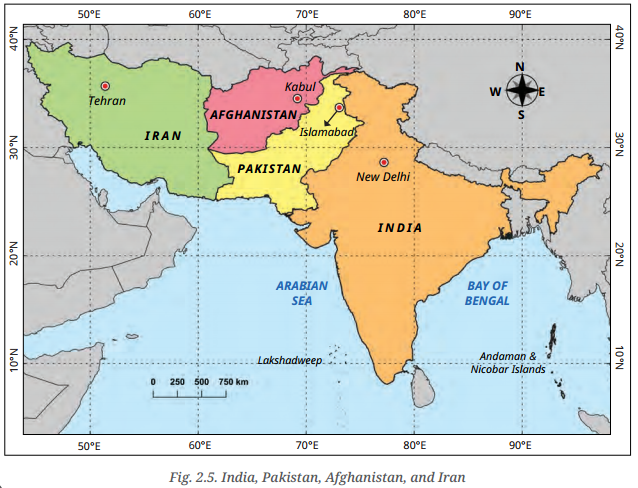
The border between two nations stretches across which states
(a) Punjab
(b) Kashmir
(c) Ladhak
(d) All of above
Answer:
(d) All of above
Question (iii).
The Kartarpur corridor connects India with which neighbouring country?
(a) Bangladesh
(b) Rajasthan
(c) Pakistan
(d) Gujarat
Answer:
(c) Pakistan
Question (iv).
What type of relationship both nations India and Pakistan shares?
Answer:
Both nations share deep cultural roots but have a strained relationship marked by the ongoing Kashmir disputes and several other wars. Relations have seen border-related tensions in recent years but both countries are making efforts to resolve issues.
2. Read the following extract and answer the questions that follow:
Nestled in the lap of the Himalayas, Nepal shares a long and open border with India, stretching across the Indian states of Uttarakhand, Uttar Pradesh, Bihar, West Bengal, and Sikkim. This geographical proximity has allowed for centuries of interaction and cooperation between the two nations and the relationship is marked by shared heritage, spiritual linkages, cross-border movement, and political partnerships.
Culturally, the ties between India and Nepal are profound. Pilgrims from both countries regularly visit sacred sites across the border. The Pashupatinatha temple in Kathmandu, a major Hindu pilgrimage destination, draws thousands of Indian visitors every year. Festivals such as Dashain (Dashahara), Tihar (Dipavali), and Holi are observed with equal enthusiasm in both countries. These shared spiritual traditions strengthen the people-to-people bonds and reflect a rich tapestry of mutual cultural appreciation,
Question (i).
The ‘Treaty of Peace and friendship’ (1950) is between India and :
(a) Pakistan
(b) Nepal
(c) China
(d) Bangladesh
Answer:
(b) Nepal
Question (ii).
Which God is worshipped in famous Pashupatinatha Temple, Kathmandu?
(a) Lord Vishnu
(b) Lord Brahma
(c) Lord Shiva
(d) Lord Krishna
Answer:
(c) Lord Shiva
Question (iii).
Which are the common festivals celebrated with equal enthusiam in both countries?
(a) Holi
(b) Deepawali
(c) Both (a) and (b)
(d) Rakshabandhan
Answer:
(c) Both (a) and (b)
Question (iv).
What does India export to Nepal and in return what does Nepal exports?
Answer:
India supplies essential goods such as petroleum, medicines, food items and manufactured products. In return, Nepal exports agricultural products, handicrafts and garments.
India and Her Neighbours Class 7 Picture Based Questions
I. Study the picture given below carefully and answer the following questions :
Question 1.
Which countries emblem can your depict in picture?
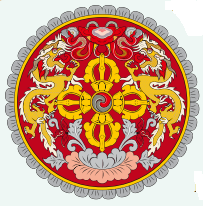 Fig. 2.10. The emblem of Bhutan. Notice the dragons that symbolise the ‘Land of the Thunder Dragon’. What other elements look familiar?
(a) Bangladesh
(b) China
(c) Nepal
(d) Bhutan
Answer:
(d) Bhutan
Question 2.
What does dragons in emblem symbolises?
(a) Nation’s name
(b) Strength
(c) Spritual balance
(d) All of above
Answer:
(d) All of above
Question 3.
Name the key familiar elements in emblem.
Answer:
The key familiar elements that can be seen in the emblem are male and female dragon representing the country name, Lotus placed below the crossed thunderbolts, symbolizing purity, jewel (Norbu) symbolizes the sovereign power of the people.
II. Study the picture given below carefully and answer the following questions :
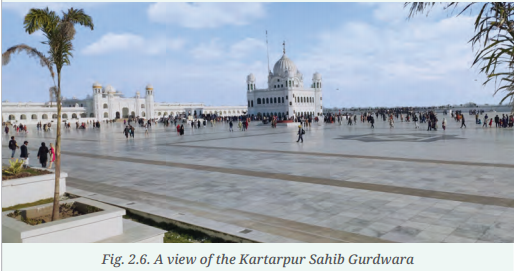
Question 1.
Name the Gurdwara you can see in picture.
(a) Banglasahib
(b) Harmandir sahib
(c) Kartarpur sahib
(d) Hazur sahib
Answer:
(c) Kartarpur sahib
Question 2.
In which year the corridor was officially opened?
(a) 2018
(b) 2019
(c) 2020
(d) 2015
Answer:
(b) 2019
Question 3.
Can a Kartarpur corridor be a model for the possible of peace and dialogue?
Answer:
Yes, the Kartarpur corridor can be a model for peace and dialogue, acting as a ‘bridge of hope’ by facilitating people-to-people contact and demonstrating cooperation a shared cultural heritage.
India and Her Neighbours Class 7 Map Based Questions
Question 1.
Name and label India’s neighbours on map of india.
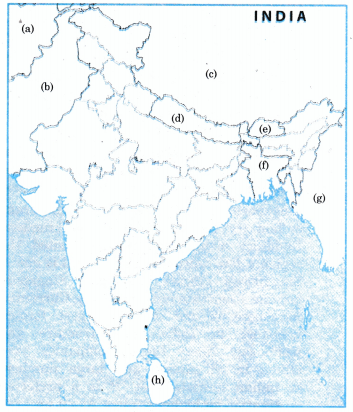
Answer:
(a) Afghnistan
(b) Pakistan
(c) China
(d) Nepal
(e) Bhutan
(f) Bangladesh
(g) Myanmar
(h) Sri Lanka
Question 2.
Write the names of India’s maritime map of India neighbours.
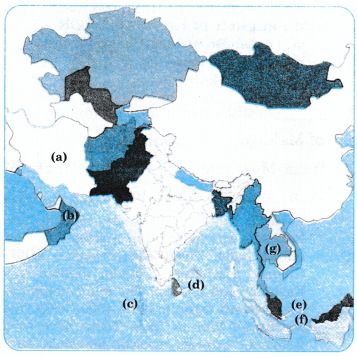
Answer:
(a) Iran
(b) Oman
(c) Maldives
(d) Sri Lanka
(e) Singapore
(f) Indonesia
(g) Thailand
Class 7 India and Her Neighbours Extra Questions for Practice
MCQs
Question 1.
The ancient trade route ‘Uttarapatha’ linked the Ganga plains to which region?
a) Southeast Asia
b) Central Asia
c) Southern India
d) Eastern Europe
Question 2.
In 2004, a massive tsunami was triggered by an earthquake near:
a) Japan
b) Indonesia
c) California
d) Chile
Question 3.
The ‘Boduberu’ dance of the Maldives echoes rhythms from which Indian culture?
a) Punjabi
b) Bengali
c) Tamil
d) Gujarati
Question 4.
Which metal was likely imported by Harappan traders from Oman?
a) Gold
b) Silver
c) Copper
d) Iron
Question 5.
‘Ayutthaya’, an ancient kingdom in Thailand, was named after which Indian city?
a) Ayodhya
b) Mathura
c) Kashi
d) Dwarka
Very Short Answer Type Questions:
Question 1.
Name the narrow stretch of sea which divide India from Sri Lanka.
Question 2.
Write the name of communities involved in Sri Lanka’s civil war during mid 1980s to 2010.
Question 3.
What is the official language of Singapore.
Question 4.
Which Buddhism is widely practiced in Thailand.
Question 5.
In which country does Suvarnabhumi Airport situated?
Short Answer Type Questions:
Question 1.
Write the name of India’s neighbouring including maritime neighbours.
Question 2.
Write a short note on India and Nepal’s trading relation.
Question 3.
The relationship has not always been smooth, describe one such time between India and Sri Lanka.
Long Answer Type Questions:
Question 1.
How can you say that India and Thailand have been connected since ancient times through trade and cultural exchange?
Question 2.
The shared history and culture and vision for the future, have played a significant role in expanding bilateral relations between India and Indonesia. Describe this statement.
Class 7 SST Extra Questions
More from Class 7
- Banks and the Magic of Finance Class 7 Extra Questions and Answers SST Part 2 Chapter 8
- Infrastructure: Engine of India’s Development Class 7 Extra Questions and Answers SST Part 2 Chapter 7
- The State, the Government, and You Class 7 Extra Questions and Answers SST Part 2 Chapter 6
- India, a Home to Many Class 7 Extra Questions and Answers SST Part 2 Chapter 5
- Turning Tides: 11th and 12th Centuries Class 7 Extra Questions and Answers SST Part 2 Chapter 4
- Empires and Kingdoms: 6th to 10th Centuries Class 7 Extra Questions and Answers SST Part 2 Chapter 3
More in Social Science
- Banks and the Magic of Finance Class 7 Extra Questions and Answers SST Part 2 Chapter 8
- Infrastructure: Engine of India’s Development Class 7 Extra Questions and Answers SST Part 2 Chapter 7
- The State, the Government, and You Class 7 Extra Questions and Answers SST Part 2 Chapter 6
- India, a Home to Many Class 7 Extra Questions and Answers SST Part 2 Chapter 5
- Turning Tides: 11th and 12th Centuries Class 7 Extra Questions and Answers SST Part 2 Chapter 4
- Empires and Kingdoms: 6th to 10th Centuries Class 7 Extra Questions and Answers SST Part 2 Chapter 3