Class 9 English Kaveri Chapter 2 Question Answer The Pot Maker
The Pot Maker Class 9 Question Answer
Check Your Understanding - (Page 37)
I. Do you think pot making is easy? Why/Why not?
Answer:
No, pot making is not easy. It requires hard physical labour, skill, patience, and careful handling of clay. The process is long and tiring.
II. Would Sentila be able to fulfil her dream? Explain.
Answer:
Yes, Sentila would fulfil her dream because she is determined and keeps learning despite difficulties.
III. Do you think Mesoba and Arenla would support Sentila? Give a reason.
Answer:
Yes. Mesoba openly supports her, and Arenla eventually teaches her the skill.
Check Your Understanding - Page 41
I. Do you think Onula's support helped Sentila? Why?
Answer:
Yes. Onula helped Sentila gain confidence and understand the technique properly. Her encouragement reduced Sentila's fear and tension.
II. Sentila observes her mother making pots. What does this tell us about her?
Answer:
It shows that Sentila is attentive, eager to learn, and serious about mastering the craft.
Check Your Understanding - (Page 42)
III. Arrange the following events of the story in the correct sequence. Share your answer with your classmates and teacher.
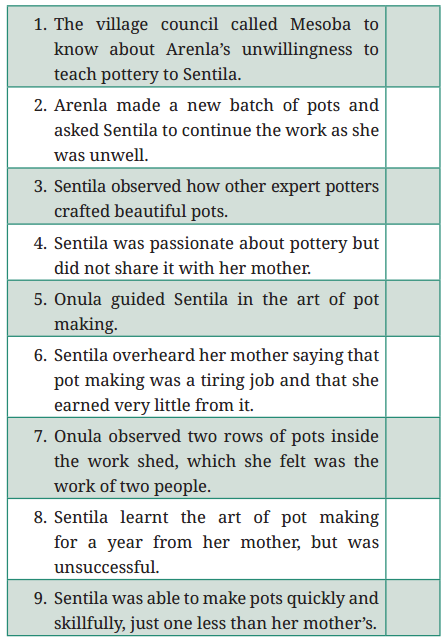
Answer:
Correct Order | |
1. Sentila overheard her mother saying pot making was tiring and poorly paid. | 6 |
2. Sentila was passionate about pottery but did not share it. | 4 |
3. Sentila observed expert potters. | 3 |
4. The village council called Mesoba. | 1 |
5. Sentila learnt from her mother for a year but failed. | 8 |
6. Onula guided Sentila. | 5 |
7. Arenla made a batch and asked Sentila to continue. | 2 |
8. Sentila made pots skillfully, one less than her mother. | 9 |
9. Onula saw two rows of pots and realised a new pot maker was born. | 7 |
Class 9 English The Pot Maker Question Answer
Critical Reflection (NCERT Pages 42-45)
I. Read the extracts given below and answer the questions that follow.
1. Pounding the stubborn clay inside bamboo cylinders to soften it, is also tedious. So many times I've dropped the mould out of sheer exhaustion and have had to start all over again. It takes months to bring out a batch of pots after so much labour. And the reward? A few rupees. But if Sentila learns weaving, she can make much more money besides providing enough cloth for the family. Weaving is not messy like pot making and can be done indoors in all seasons. Also, the time spent on weaving one shawl is much less and the return is handsome.
(i) Choose the correct reason for the given assertion
(A): The effort in making pots is far greater than the returns.
A. The process of Pot making is quite tiresome, long and hardly earn much.
B. The process of Pot making is exhausting take a long time, yet gives a sense of satisfaction.
Answer:
A. The process of pot making is quite tiresome and long, and one hardly earns much.
(ii) Why does Arenla want Sentila to learn weaving?
Answer:
Arenla wants Sentila to learn weaving because it can earn her more money, provide clothing for the family, and can be done indoors in all seasons without the mess and physical strain of pot making.
(iii) State one advantage that weaving has over pot making, as per the extract.
Answer:
The time spent on weaving a single shawl is much less than producing a batch of pots, and the financial return is better.
(iv) Choose the sentence that uses the word 'handsome' in the same way as in the extract.
Answer:
They will make a handsome profit selling this property. (In both contexts, 'handsome' refers to a large or substantial amount of money).
(v) 'And the reward?' What is the author's purpose of using a question mark here?
Answer:
The author uses a question mark to highlight the disappointing and disproportionately small amount of money (a pittance) received compared to the extreme labor involved.
The Pot Maker Class 9 Questions and Answers
2. Onula saw her taking out some clay and the implements from her basket quietly. She watched Sentila's clumsy efforts to make a pot and noticed that Sentila was too tense. As a result, the clay seemed unable or unwilling to yield the right shape. When Sentila wearily let the misshapen lump fall flat on the ground, Onula went to her and said, "Don't worry, little one, I shall teach you how to make a perfect pot." Sentila watched in amazement as Onula fashioned a beautiful pot and asked her to try again.
(i) Complete the sentence with an appropriate reason. Onula feels Sentila's effort at making a Pot is clumsy because ...............
Answer:
Onula feels Sentila's effort at making a pot is clumsy because Sentila was too tense, which prevented the clay from yielding the right shape.
(ii) Choose the correct option to complete the following sentence regarding Onula's offer to teach. 'Don't worry little one, I shall teach you how to make a perfect pot?
This shows that Onula was .............
A. sincere and generous
B. forgiving and thoughtful
C. thoughtful and generous
D. forgiving and sincere
Answer:
thoughtful and generous.
(iii) Which among the following is the effect of a cause?
A. As a result, the clay seemed unable or unwilling to yield the right shape. (The cause was Sentila being too tense).
B. Onula saw her taking out same clay and the implements from her basket quiety.
Answer:
A. As a result, the clay seemed unable or unwilling to yield the right shape. (The cause was Sentila being too tense).
(iv) 'Onula fashioned a beautiful pot.' Here, the word 'fashioned' means ............ (created/style)
Answer:
Created.
(v) How might Sentila have felt when she saw 'the misshapen lump fall flat on the ground'?
Answer:
Sentila felt a deep sense of shame, frustration, and weariness.
II. Short Answer Questions (Page 44)
Question 1.
Describe the process of pot making as observed by Sentila.
Answer:
Sentila observed experts mixing clay with water and pounding it. She watched them push their left hand into the clay while deftly rotating the lump and using a spatula in the right hand to tap and shape it.
Question 2.
What warning was given to Mesoba by the village council?
Answer:
The council reminded Mesoba that it was Arenla's duty to pass on her skills, as traditions do not belong to individuals but to the community's history. They warned that experts are obliged to teach anyone who wishes to learn to ensure the craft survives.
Question 3.
How did Sentila feel when she failed at pot making even after a year of training?
Answer:
She felt extreme shame and frustration, often hanging her head in silence as she watched her mother easily transform the clay into beautiful pots that she herself could not shape.
Question 4.
'Onula stood there for a long time as if trying to absorb a new phenomenon'. Explain.
Answer:
Onula was witnessing a profound revelation',the birth of a new expert potter. She saw two rows of pots that were so perfectly symmetrical and identical in skill that she could not tell which were made by the mother and which by the daughter.
Question 5.
'The tradition and history of the people did not belong to any individual,' what does this symbolise?
Answer:
This symbolises that cultural heritage and traditional skills are a collective legacy. It means no one has the right to let a skill die out simply because they find it difficult or unprofitable; they have a social responsibility to keep their history alive.
Question 6.
What is the significance of the concluding line, 'A new pot maker was born'?
Answer:
It signifies that despite Arenla's death, her skill and legacy did not die. Sentila successfully inherited the "dexterity" and "momentum" of her mother, ensuring the village would continue to have an expert potter.
Question 7.
What is the role of perseverance in pursuing one's dreams? Elaborate with reference to Sentila.
Answer:
Sentila's journey shows that passion requires persistence. Despite her mother's discouragement, a year of failure, and physical exhaustion, she never gave up. Her determination to keep visiting potters and practicing in secret eventually led to her mastery.
Vocabulary and Structures in Context
I. Read the highlighted words in the following sentences from the text.
1. She taught Sentila how to dig the clay with dao, load it on to her carrying basket...
2. Sentila was a quick learner and turned the clay into malleable dough. Pounding the stubborn clay inside bamboo cylinders to soften it...
The highlighted words describe the tools and materials required in the process of pot making.
Now, classify the words/phrases given in the box as shown in the table below. One example for each category has been done for you.
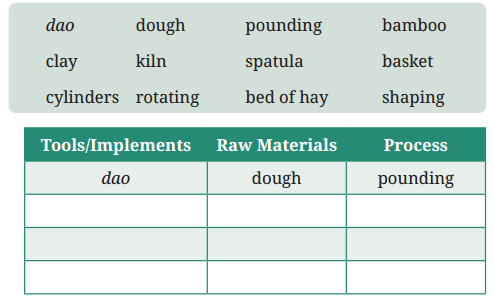
Answer:
Tools/Implements | Raw Materials | Process |
dao spatula basket cylinders kiln | dough wood/bamboo bamboo bed of hay Clay | pounding rotating shaping .............. rotating |
II. Notice the use of the following words in the text.

These words relate to livelihood and economic aspects that are crucial for any enterprise/business/vocation.
Work in pairs and find the meanings of the following words related to economy. You may refer to a dictionary.

Now, frame sentences using each word.
Answer:
1. Bankrupt: A person or organization declared by law as unable to pay their debts.
Sentence: The small craft shop went bankrupt because it could not compete with factory-made goods.
2. Credit: An agreement where a customer can purchase goods before payment, based on trust.
Sentence: The potter allowed the villagers to buy pots on credit during the festival season.
3. Currency: A system of money in general use in a particular country.
Sentence: The traveller had to exchange her local currency before visiting the international art exhibition.
4. Debt: Something, typically money, that is owed or due.
Sentence: After taking a loan to build a new kiln, the family worked hard to clear their debt.
5. Fiscal: Relating to government revenue, especially taxes.
Sentence: The government introduced new fiscal policies to support traditional artisans.
6. Inflation: A general increase in prices and fall in the purchasing value of money.
Sentence: Due to inflation, the cost of raw materials like grey and red clay has increased significantly.
7. Investment: The action of putting money into something for profit or material result.
Sentence: Buying a modern pottery wheel was a great investment for Sentila's future business.
8. Interest: Money paid regularly at a particular rate for the use of money lent.
Sentence: The bank charged a low rate of interest on loans provided to small-scale weavers.
III. Read the following sentences from the text. The main clause has been underlined and the subordinate clause has been circled.
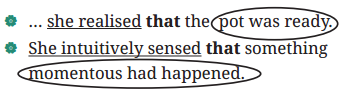
Subordinate clauses that act like nouns and perform the same functions as subject or object are called noun clauses.
Question 1.
Complete the following sentences with suitable noun clauses.
(i) The elders emphasised that .............
Answer:
traditional skills must be passed on to the next generation
(ii) Mesoba explained why .............
Answer:
Arenla had delayed teaching Sentila the skill of pot making
(iii) Onula's promise was that .............
Answer:
she would teach Sentila how to make a perfect pot
(iv) Sentila observed her mother carefully when she was shaping the mouth of the pot, which ............
Answer:
helped her understand the correct technique
(v) The kiln, where ............ required careful attention to prevent over-or-under firing.
Answer:
the pots were fired
Question 2.
Read the following sentences from the text. Underline the main clause and circle the subordinate clause.
Relative clauses act like adjectives to give further description of a noun.
Underline the main clause and circle the subordinate clause:
(i) Arenla took Sentila to the riverbank where the grey and red clay was found.
Answer:
- Main Clause: Arenla took Sentila to the riverbank.
- Subordinate Clause: where the grey and red clay was found.
(This is a relative clause describing "riverbank.")
(ii) She started on the next one, and like a sprinter who had suddenly found momentum...
Answer:
- Main Clause: She started on the next one.
- Subordinate Clause: who had suddenly found momentum.
(This is a relative clause describing "sprinter.")
(iii) Skills such as pot making which not only catered to the needs of the people...
Answer:
- Main Clause: Skills such as pot making...
- Subordinate Clause: which not only catered to the needs of the people...
(This is a relative clause describing "skills" or "pot making.")
Question 3.
Complete the following sentences with suitable relative clauses.
(i) Sentila, whose ............ practised the craft diligently.
Answer:
passion for pottery was deep
(ii) The village council, where ............ , sought an explanation for Arenla's reluctance.
Answer:
the elders gathered
(iii) The potter's hands, which ............ , shaped the clay into beautiful creations.
Answer:
were covered in grey clay
(iv) Arenla, her mother, wanted her to learn weaving, which ............ .
Answer:
offered a better financial return.
(v) Mesoba went home and discussed the matter with Arenla, who ............ .
Answer:
eventually agreed to teach their daughter.
Question 4.
Read the highlighted words in the following lines from the text.
- Onula saw her taking out some clay...
- ... make as many pots as they could.
- ..... did not belong to any individual.
- Slowly she walked away from this place of wonder.
- ... they would not have enough days of sunshine ...
The highlighted words are determiners.
Determiners are words that come before nouns and specify something about their quantity, definiteness, or ownership.
Here is a list of the most frequently used determiners -
- a, an, the (Articles)
- this, that, these, those (Demonstratives)
- my, our, your, his, her, its, their, one's (Possessives)
- one, two, three, etc. (Definite numerals)
- some, any, no, all, both, much, many, few, less, several, little (Indefinite numerals)
- each, every, either, neither (Distributives)
(i) Find out some more determiners from the text.
Answer:
Determiners specify quantity, definiteness, or ownership of a noun.
(ii) Fill in the banks with suitable determiners. The first two blanks have been done for you.
A. The florist arranged five bouquets for her clients, that were displayed in ............ elegant floral shop.
B. The carpenter crafted ............ unique tables, and ............ became the centrepiece in ............ furniture collection.
C. ............ of ............ apprentices in ............ culinary class demonstrated ............ knife skills during the intense cooking session.
D. ............ of ............ sculptures were displayed at ............ art exhibition, showcasing ............ diverse artistic skills.
Answer:
(A) an
(B) two, unique centrepiece, best
(C) All, the, the, their
(D) Some, their, an, their
Listen and Respond
I. You will listen to a man speak about stone statues. As you listen, complete the given paragraph by filling in the blanks with the exact words you listen to. (Transcript for teacher on page 261)
A statue is carved to create a shape that is 1. ............ . Among the many things stone is used for making stone 2. ............ is one of them. India has some of the most 3. ............ stone sculptures, as is obvious from its many stone monuments across the country.
Answer:
1. visually interesting.
2. sculptures
3. fascinating and mesmerising
II. You will now listen to the man speaking about some steps involved in making stone statues. As you listen, select the six correct steps out of the nine given. (Transcript for teacher on page 261)
1. carve to remove large unwanted portions of the stone
2. set up the different tools
3. measure the weight and dimensions of the statue
4. leave the statue in water to firm up overnight
5. refine the creation within the stone
6. choose the stone
7. begin carving from the centre
8. detach the creation from the stone as the final statue
9. work to bring out the imagined shape
Answer:
1. Carve to remove large unwanted portions of the stone
3. Measure the weight and dimensions of the statue
5. Refine the creation within the stone
6. Choose the stone
8. Detach the creation from the stone as the final statue
9. Work to bring out the imagined shape
Speaking Activity
Work in pairs and choose two characters from the story-Sentila and one other character [Arenla, Mesoba, Onula, or a village elder].
Prepare to speak from the chosen character's perspective based on information from the story and the understanding of the intentions of the characters.
Prepare a role-play between Sentila and the chosen character. The conversation between the characters should cover the following points.
- Sentila's desire to learn pot making
- the challenges she faces
- the advice or perspective the other character offers
Students can use direct quotes from the story and creatively expand on the characters' thoughts and feelings.

You may use the following sentence prompts.
- I feel/felt ............ because...
- I wish/wished ............ because...
- When you said/did ............, it made me feel/think ........... because...........
Answer:
Role-Play: Sentila and Onula
Context: This conversation takes place after Onula watches Sentila struggle with the clay in the dormitory.
Onula: Don't worry, little one. I saw you trying to work the clay, but you are too tense. If you are not relaxed, the clay will never yield the right shape.
Sentila: I feel so frustrated because I want to be a pot maker like my mother, but I am so clumsy. My mother says pot making is just "pittance for her troubles" and wants me to weave instead.
Onula: I understand your desire. When you work with your mother next time, watch her rhythm carefully, especially how she shapes the rim. I shall teach you how to make a perfect pot right now.
Sentila: When you said you would help me, it made me feel a confidence I have never felt before. I wish to prove that I can carry on our tradition.
Writing Task
Reflective Writing - Identifying Skills and Passion
Reflective writing encourages introspection and thoughtful exploration of personal experiences, skills, and aspirations. It helps individuals gain deeper insights into themselves and their goals through structured reflection.
I Follow the steps given below to create a write-up about your skills and passions.
Step 1: Introduction
Reflect on your passions and the skills you currently possess or are developing. Consider why these activities or interests are meaningful and enjoyable to you.
Step 2: Describing skills
Describe specific activities or practices you engage in to nurture your skills. This could include hobbies, classes (art, music, coding, etc.), workshops, or personal projects.
Step 3: Passion into profession
Identify which of these skills you believe have the potential to turn your passion into a profession. Explain why you think these skills are crucial or advantageous in your chosen field.
Step 4: Examples and reflection
Provide examples or anecdotes that illustrate how your skills and passions complement each other. Reflect on how these experiences have shaped your career aspirations and personal growth.
Step 5: Conclusion
Summarise your reflections. Discuss any insights gained about yourself, your skills, and your career ambitions through this exercise.
Answer:
My Path to Craftsmanship
Step 1: Introduction My greatest passion is graphic design. I have always been drawn to how colors and shapes can tell a story without using words. This activity is meaningful to me because it allows me to combine technology with creativity to solve visual problems.
Step 2: Describing Skills To nurture this skill, I spend my weekends experimenting with digital illustration tools. I also attend online workshops to learn about typography and layout design. I often create posters for school events to practice my craft in a real-world setting.
Step 3: Passion into Profession I believe digital illustration has the potential to become my profession. In today's world, every business needs a visual identity. My ability to translate complex ideas into simple icons is an advantage in the field of marketing and branding.
Step 4: Examples and Reflection An example of my growth was when I designed a logo for a local charity. Seeing my work used to help others shaped my career aspirations; it made me realize that my passion can have a positive social impact. Much like Sentila's "momentum," I find that once I start a design, hours pass by in what feels like minutes.
Step 5: Conclusion Through this reflection, I've realized that my hobby is more than just a pastimeit is my identity. I have gained the insight that persistence is just as important as talent, and I am now more determined than ever to pursue design as my life's vocation.
Kaveri Book Class 9 Solutions
More from Class 9
- Class 9 English Kaveri Chapter 1 Question Answer How I Taught My Grandmother to Read
- Kaveri Book Class 9 Solutions - Kaveri Class 9 Solutions
- Believe in Yourself Class 9 Summary in English & Hindi
- Words Class 9 Summary in English & Hindi
- A Friend Found in Music Class 9 Summary in English & Hindi
- Nine Gold Medals Class 9 Summary in English & Hindi
More in English
- Class 9 English Kaveri Chapter 1 Question Answer How I Taught My Grandmother to Read
- Kaveri Book Class 9 Solutions - Kaveri Class 9 Solutions
- Believe in Yourself Class 9 Summary in English & Hindi
- Words Class 9 Summary in English & Hindi
- A Friend Found in Music Class 9 Summary in English & Hindi
- Nine Gold Medals Class 9 Summary in English & Hindi