The State, the Government, and You Class 7 Extra Questions and Answers SST Part 2 Chapter 6
The State, the Government, and You Class 7 Extra Question Answer
Question 1.
What are the four essential parts that make up a state?
Answer:
The four essential parts of a state are people (permanent population), land (fixed territory with clear boundaries), government (system to run the country), and sovereignty (complete power to make laws independently).
Question 2.
What does sovereignty mean for a state?
Answer:
Sovereignty means the state has complete control over its own matters and can make laws according to its needs. No other state or external body can interfere in its internal affairs.
Question 3.
How is the government different from the state?
Answer:
The government is just one part of the state that runs the country through leaders and officials. The government can change after elections, but the state remains the same.
The State, the Government, and You Class 7 Very Short Question Answer
Question 4.
What does permanent population mean in the context of a state?
Answer:
Permanent population means people who identify with a place and usually live there, not just tourists visiting. This group develops its own culture and society connected to its territory.
Question 5.
What are the main responsibilities of the police in maintaining law and order?
Answer:
Police maintain law and order, ensure people live safely free from crime and violence, investigate cases and present them to the judiciary, and work closely with courts and the criminal justice system.
Question 6.
What is the core meaning of democracy?
Answer:
Democracy means ‘rule by the people’ where people have the power to choose their government through free and fair elections. The word comes from ‘demos’, meaning people, and ‘kratos’, meaning rule.
Extra Questions of The State, the Government, and You Class 7
Question 7.
What is a republic, and how is its head of state chosen?
Answer:
In a republic, the head of state is elected by the people directly or indirectly, rather than being a king or queen who inherits power through family lineage.
Question 8.
Why did India choose to be a republic after independence?
Answer:
India did not blindly adopt the British system, which has a monarch. Constitution makers decided India’s President would be elected by elected representatives, making India a democratic republic.
Question 9.
How does India’s Constitution protect citizens’ rights in a republic?
Answer:
India’s Constitution guarantees fundamental rights to all citizens and ensures that majority rule does not violate anyone’s basic rights like equality, freedom of speech, and freedom of religion.
Question 10.
What did Kautilya believe about the need for government?
Answer:
According to Kautilya, without government, society becomes chaotic with the powerful eating the weak. This is called Matsya nyaya, meaning “big fish swallow smaller ones” in his Arthashastra.
Question 11.
What is the main function of the legislature in a democratic government?
Answer:
The legislature is a branch of government that makes laws for the country and represents the people. It ensures governance happens through well-defined laws, not arbitrary personal decisions.
Question 12.
What are the two main responsibilities of the executive branch of government?
Answer:
The executive is responsible for implementing or executing laws formulated by the legislature. It also takes policy decisions, which are sets of ideas or actions that the government decides on.
Question 13.
Who makes up the political executive in - India’s government?
Answer:
The political executive consists of elected leaders, including the Prime Minister, Chief Ministers, their ministers, and the President and Governors. They make big decisions and stay in power for usually five years.
Question 14.
What is the role of permanent executives or bureaucrats in government?
Answer:
Permanent executive includes government officers selected through examinations who work continuously regardless of elections. They offer expert advice, implement policies, manage public services, and keep the government running smoothly.
Question 15.
Who was Chonira Belliappa Muthamma, and what was her achievement?
Answer:
Chonira Belliappa Muthamma was the first woman to join the Indian Foreign Service in 1949. She became India’s first woman ambassador and fought against gender- biased provisions through the Supreme Court.
Question 16.
What are the three main roles of the government of India?
Answer:
The government of India plays a triple role: protector (law and defence), provider (public welfare and infrastructure), and regulator (economic activity and social justice) for all citizens.
Question 17.
What is the Right to Information Act, and how does it help citizens?
Answer:
The RTI Act is a powerful law through which citizens can ask for information about government actions of public interest. Officials are bound to provide information, bringing transparency and accountability.
Question 18.
What are the main functions of the judiciary in a democracy?
Answer:
The judiciary protects and defends laws, interprets complex laws, protects citizens’ rights and liberty, and safeguards the Constitution through judicial review as an independent referee against unfair actions.
Question 19.
Why is an independent judiciary important for democracy?
Answer:
An independent judiciary protects the rule of law, keeps checks on unfair actions, ensures laws don’t harm people’s rights, and resolves conflicts peacefully. Without it, democracy cannot survive properly.
Question 20.
How many levels of government originally existed under India’s Constitution?
Answer:
Originally, the Constitution provided for only two levels of government: the Union Government for the entire country and State governments for each state. Local governments were not separate constitutional levels.
The State, the Government, and You Class 7 Short Question Answer
Question 1.
What is sovereignty and why is it an essential feature of a state?
Answer:
Sovereignty means a state has complete control over its own matters and can make laws according to its needs without external interference. It is essential because it establishes the state’s authority to govern independently. No other state or external body can interfere in the internal affairs of a sovereign state. This ensures the state can protect its citizens’ interests and maintain its own identity and decision-making power.
Question 2.
Explain the difference between political executive and permanent executive with examples.
Answer:
Political executive consists of elected leaders like the Prime Minister, Chief Ministers, and their ministers who make major policy decisions and stay in power for a fixed term. Permanent executive includes bureaucrats like IAS, IPS officers selected through competitive examinations who implement policies and provide expert advice. Political executive changes with elections, whilst permanent executive continues regardless of which party is in power, ensuring continuity in governance.
Question 3.
How does an independent judiciary protect democracy in India?
Answer:
An independent judiciary protects democracy by ensuring everyone, including the government, follows the law. It safeguards citizens’ fundamental rights guaranteed by the Constitution through judicial review. The judiciary acts as a referee, checking whether laws are fair and preventing any branch of government from becoming too powerful. It resolves conflicts peacefully and protects minorities from majority dominance. Without a strong, independent judiciary that interprets and defends laws impartially, democracy cannot survive.
Question 4.
Describe three ways through which citizens can make the government work for them.
Answer:
Citizens can file complaints through government grievance redressal offices and online portals like the Public Grievances Portal. They can use the Right to Information Act to seek information about government actions, bringing transparency and accountability. Citizens can engage through civil society organisations or NGOs that work on issues like education, health, and environment. They can also write to political representatives, use media platforms to . share concerns, and most importantly, vote inelections to elect responsible leaders.
The State, the Government, and You Class 7 Long Question Answer
Question 1.
Explain the concept of decentralisation and why it is important for India’s governance.
Answer:
Decentralisation means power and decision-making are spread out and not concentrated in one place or a small group. Local problems should be solved locally, whilst bigger issues are solved by higher-level governments. Decentralisation is important because it makes governance more democratic by involving people in decisions affecting their daily lives. Local leaders know their area’s needs and traditions better than distant officials. When leaders are closer to people, it is easier to question them and ensure accountability. This strengthens local governments like panchayats and municipalities, making them lively places where people participate actively.
Question 2.
Describe the three tiers of government in India and explain how they were established.
Answer:
India has three tiers of government. Originally, the Constitution provided only two levels: the Union Government for the entire country and State governments for each state. Local governments were not separate constitutional levels initially. In the early 1990s, the Constitution was amended to create the panchayati raj system for villages and the system of municipalities for towns and cities. This made local governments the third tier of India’s democracy. This was done to strengthen democracy at the grassroots level and enable people to participate directly in decision-making about local matters.
Question 3.
How did Chonira Belliappa Muthamma contribute to gender equality in the Indian public service?
Answer:
Chonira Belliappa Muthamma was the first woman to clear the examination for public services in 1948 and join the Indian Foreign Service in 1949. She faced strong gender bias, as women had to sign undertakings to resign if they got married. Despite this, she conducted a distinguished diplomatic career and became India’s first woman ambassador in several countries. When unjustly denied promotion, she approached the Supreme Court. Justice Krishna Iyer struck down gender-biased provisions as violating the Constitution. Her struggle remains a milestone in the pursuit of gender equality in the Indian public service.
Question 4.
Explain the triple role that the government of India plays in citizens’ lives with examples.
Answer:
The government of India plays three important roles. First, as a protector, it maintains law and order through police forces and ensures the defence of the country. Second, as a provider, it provides free education by building schools and hiring teachers, and constructs infrastructure like roads, bridges, railways, and airports. Third, as a regulator, it controls economic activity and ensures social justice by taking initiatives to ensure food safety. These three roles— protector, provider, and regulator—help the government serve citizens in different ways and ensure their well-being and development.
Question 5.
How do the three organs of government work together in the context of school education?
Answer:
The three organs work together for school education. The legislature, including Parliament and State Legislatures, makes laws for Schools, like the Right to Education Act and approves budgets. For example, they mandate separate toilets for boys and girls. The executive implements these laws through . political members like ministers who guide policies and schemes, and through permanent bureaucrats like District Education Officers who ensure laws are followed and improve teacher training. The judiciary, through courts and child protection councils, protects the rights of children and takes action if these rights are denied. Together, they ensure quality education.
The State, the Government, and You Class 7 Source/Case Based Questions
1. Read the following extract and answer the questions that follow:
The Government of India plays the triple role of protector (law and defence), provider (public welfare and infrastructure), and regulator (of economic activity and social justice). As examples, the government maintains law and order to protect the people through police forces, provides education free for children by building schools and hiring teachers, constructs infrastructure like roads, bridges, railways, and airports, and takes initiatives to ensure food safety. The above roles of the government are executed through India’s Constitution, thousands of laws, many layers of elected representatives, a vast bureaucracy, and a judiciary (brief description in the next section), all of which help us greatly in our daily lives. However, you might wonder why, then, our country and her people also still face so many problems. Why do we still hear of cases of bribery and corruption in public office? We still encounter many issues that need to be addressed* — people in difficult socio-economic conditions, lack of access to good education and healthcare,
infrastructure that is of poor quality, inadequate . access to government schemes, and so on.
Question (i).
Government maintains law and order. It comes under government which role
(a) Provider
(b) Protector
(c) Regulator
(d) Both (a) and (c)
Answer:
(b) Protector
Question (ii).
Who all helps us greatly in our daily lives?
(a) Bureacrats
(b) Juidiciary
(c) Both (a) and (b)
(d) None of above
Answer:
(c) Both (a) and (b)
Question (iii).
All roles of government are executed through which body.
(a) Prime Minister
(b) President
(c) India’s Constitution
(d) People
Answer:
(c) India’s Constitution
Question (iv).
What are the three main roles of the government of India?
Answer:
The government of India plays a triple role: protector (law and defence), provider (public welfare and infrastructure), and regulator (economic activity and social justice) for all citizens.
2. Read the following extract and answer the questions that follow:
The government is just one part of the state. It can change after elections, but the state remains the same. Think of the state as a school, and the government as the principal and teachers. Teachers may come and go, but the school remains.
Why are these two words used interchangeably?
In real life, we often say “the state did this” or “the government decided that” as if they mean the same thing. This is because the government acts on behalf of the state, and is the face of the state that we see in action every day.
So, while the words are different in meaning, people often mix them up because —
- the government runs the daily work of the state;
- we usually interact with the government, not the whole state.
Question (i).
Which can changed after election?
(a) State
(b) People
(c) Government
(d) Both (b) and (c)
Answer:
(c) Government
Question (ii).
Who is the face of the state?
(a) People
(b) Government
(c) People
(d) President
Answer:
(b) Government
Question (iii).
Who all are included in government?
(a) Leaders
(b) Ministers
(c) Officials
(d) All of above
Answer:
(d) All of above
Question (iv).
Out of government and state who is more important ? How?
Answer:
Government is more important as
- the government runs the daily work of the state;
- we usually interact with the government, not the whole state.
The State, the Government, and You Class 7 Competency Based Questions
Question 1.
The State of India remains constant, but the Government of India changes periodically through elections.” Which of the following best explains this statement?
Answer:
(a) The State and Government are the same entity.
(b) The Government is a permanent body, while the State is temporary.
(c) The Government is the agency through which the State exercises its power.
(d) The State has no power without the current ruling political party.
Question 2.
Which level of government should you approach first? Justify your answer by explaining the functions of that level.
Answer:
The local government is responsible for the direct management of basic services and public infrastructure that affect your daily life within your immediate neighborhood. Because this level of government is located closest to the citizens, it is the most efficient channel for reporting local grievances. In 2026, most local bodies have digital grievance portals or dedicated helplines (like 1916 for water in several cities) for immediate reporting.
The State, the Government, and You Class 7 Picture Based Questions
I. Study the picture given below carefully and answer the following questions :
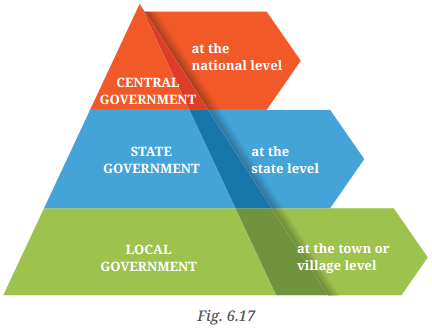
Question 1.
How many levels of government, constitution provide?
(a) 3
(b) 2
(c) 1
(d) 4
Answer:
(b) 2
Question 2.
Who decides local government works?
(a) Prime Minister
(b) Themselves
(c) State Government
(d) Judiciary
Answer:
(c) State Government
Class 7 The State, the Government, and You Extra Questions for Practice
MCQs
Question 1.
What are main roles of the government of India?
(a) Protector
(b) Provider
(c) Regulator
(d) All of above
Question 2.
How many levels of government originally existed under India’s Constitution?
(a) 4
(b) 3
(c) 2
(d) 1
Question 3.
What are main essential parts that made a state?
(a) People
(b) Land
(c) Government
(d) All of above
Question 4.
What is the exact meaning of democracy?
(a) ‘Role of Government’
(b) ‘Rule by the People’
(c) ‘Role of People’
(d) ‘Rule by the Government’
Question 5.
In republic how the head of state chosen?
(a) By Government
(b) By the King
(c) By the People
(d) By the Queen
Very Short Answer Type Questions
Question 1.
What is the form of democracy where people elect representatives?
Question 2.
Name the temporary authority that runs the affairs of the state.
Question 3.
Why is the essential feature that makes a state sovereign?
Short Answer Type Questions
Question 1.
Explain how the three organs of government work together.
Question 2.
How do civil society organisations strengthen democracy?
Question 3.
Describe any two ways citizens can participate in ensuring better governance in India.
Long Answer Type Questions
Question 1.
If you were a citizen facing poor roads, lack of healthcare, or corruption, what steps could you take to make the government act?
Question 2.
Explain the importance of the permanent executive.
Class 7 SST Extra Questions
More from Class 7
- Banks and the Magic of Finance Class 7 Extra Questions and Answers SST Part 2 Chapter 8
- Infrastructure: Engine of India’s Development Class 7 Extra Questions and Answers SST Part 2 Chapter 7
- India, a Home to Many Class 7 Extra Questions and Answers SST Part 2 Chapter 5
- Turning Tides: 11th and 12th Centuries Class 7 Extra Questions and Answers SST Part 2 Chapter 4
- Empires and Kingdoms: 6th to 10th Centuries Class 7 Extra Questions and Answers SST Part 2 Chapter 3
- India and Her Neighbours Class 7 Extra Questions and Answers SST Part 2 Chapter 2
More in Social Science
- Banks and the Magic of Finance Class 7 Extra Questions and Answers SST Part 2 Chapter 8
- Infrastructure: Engine of India’s Development Class 7 Extra Questions and Answers SST Part 2 Chapter 7
- India, a Home to Many Class 7 Extra Questions and Answers SST Part 2 Chapter 5
- Turning Tides: 11th and 12th Centuries Class 7 Extra Questions and Answers SST Part 2 Chapter 4
- Empires and Kingdoms: 6th to 10th Centuries Class 7 Extra Questions and Answers SST Part 2 Chapter 3
- India and Her Neighbours Class 7 Extra Questions and Answers SST Part 2 Chapter 2