The Story of Indian Farming Class 7 Extra Questions and Answers SST Part 2 Chapter 1
The Story of Indian Farming Class 7 Extra Question Answer
Question 1.
What is terracing in agriculture?
Answer:
Terracing means creating flat steps in hilly areas to slow down water runoff. This method is used on hill slopes to prevent soil erosion.
Question 2.
How does drip irrigation work?
Answer:
Drip irrigation delivers water slowly and directly to plant roots through tubes and emitters. This method uses water efficiently and saves resources.
Question 3.
What is Beejamrit used for?
Answer:
Beejamrit is a paste made of cow dung and urine used to coat seeds before planting. It protects seeds and reduces germination time.
The Story of Indian Farming Class 7 Very Short Question Answer
Question 4.
Who introduced the Green Revolution in India?
Answer:
M .S. Swaminathan introduced the Green Revolution in India during the 1960s-1970s. It used high-yielding seeds, irrigation, chemical fertilisers, and mechanised equipment.
Question 5.
Which is the world’s first 100% organic state?
Answer:
Sikkim is the world’s first 100% organic state. It banned chemical fertilisers and pesticides in 2014 to promote sustainable and organic farming practices.
Extra Questions of The Story of Indian Farming Class 7
Question 6.
Which crops are grown in the zaid season?
Answer:
Zaid season crops include watermelon, cucumber, muskmelon, and pumpkin. These summer crops are grown between the rabi and kharif seasons.
Question 7.
What is the origin of the terms kharif, rabi, and zaid?
Answer:
The terms kharif, rabi, and zaid are Arabic words that have been used since Mughal times in India to describe crop seasons.
Question 8.
What is humus?
Answer:
Humus is dark organic matter in soil formed by the decomposition of plant and animal matter. It is rich in nutrients and retains moisture.
Question 9.
How many major soil types does India have?
Answer:
India has six major soil types: alluvial soil, black soil, red soil, laterite soil, desert soil, and mountain or alpine soil.
Question 10.
How is alluvial soil formed?
Answer:
Alluvial soil is formed by silt deposits brought by rivers from the mountains. It is very fertile and found in northern plains and river valleys.
Question 11.
What does agriculture include?
Answer:
Agriculture includes the preparation of soil, cultivation of plants, and rearing of livestock. It covers farming, animal husbandry, forestry, and horticulture.
Question 12.
What is the origin of the word agriculture?
Answer:
The word agriculture comes from two Latin words. Agri means field, and Culture means to cultivate. These words describe farming activities.
Question 13.
How much of India’s working population depends on agriculture?
Answer:
Around 46% of India’s working population depends on agriculture for their livelihood. More than 75% of agricultural workers are women.
Question 14.
What is intercropping?
Answer:
Intercropping means growing two or more different crops at the same time in the same field. This practice was used at Kalibangan around 2800 BCE.
Question 15.
Which crops are mentioned in the Vedas?
Answer:
The Vedas mention yava, which is barley, godhuma, which is wheat, and vrihi, which is t rice, along with other crops.
The Story of Indian Farming Class 7 Short Question Answer
Question 1.
What are the main types of farming in India?
Answer:
The main types of farming in India include subsistence farming, where farmers grow crops primarily for their own consumption, and commercial farming, where crops are grown for sale in markets. Additionally, there is also mixed farming, which combines crop cultivation with livestock rearing.
Question 2.
How has the Green Revolution impacted Indian agriculture?
Answer:
The Green Revolution introduced high- yielding varieties of seeds and the use of chemical fertilisers and pesticides, which significantly increased food production in India. This led to self-sufficiency in staple crops like wheat and rice, although it also resulted in environmental challenges and unequal benefits for farmers.
Question 3.
What role do monsoons play in Indian farming?
Answer:
Monsoons are crucial for Indian farming as they provide the majority of the rainfall needed for agriculture. The timing and intensity of monsoon rains directly affect crop yields and are vital for irrigation, particularly in regions that rely heavily on rain-fed agriculture.
Question 4.
What are some challenges faced by Indian farmers?
Answer:
Indian farmers face several challenges, including inadequate access to modern technology, fluctuating market prices, insufficient irrigation facilities, and the impacts of climate change. Additionally, many farmers struggle with debt and lack of financial support, leading to economic hardships.
Question 5.
How is organic farming different from conventional farming in India?
Answer:
Organic farming in India emphasises the use of natural inputs and sustainable practices, avoiding synthetic chemicals and genetically modified organisms. In contrast, conventional farming often relies on chemical fertilisers and pesticides to maximise crop yields. Organic farming aims to enhance soil health and biodiversity while addressing environmental concerns.
Question 6.
What are the differences between rain- fed and irrigated agriculture?
Answer:
Rain-fed agriculture relies solely on rainfall for water, making it vulnerable to climate variability, while irrigated agriculture uses artificial water sources such as rivers, lakes, or canals to provide a consistent water supply. Irrigated farming generally leads to higher yields and can support multiple cropping seasons compared to rain-fed farming.
Question 7.
What role does the government play in supporting Indian farmers?
Answer:
The government supports Indian farmers through various initiatives such as subsidies for seeds and fertilizers, providing minimum support prices for crops, and implementing schemes for irrigation and credit. Additionally, the government works towards improving agricultural infrastructure and promoting sustainable practices to enhance productivity.
Question 8.
What are some challenges faced by farmers in India?
Answer:
Farmers in India face numerous challenges including unpredictable weather patterns, soil degradation, limited access to modern technology, and inadequate infrastructure. Additionally, market fluctuations and the burden of debt can significantly impact their livelihoods, making it difficult for them to sustain agricultural practices.
The Story of Indian Farming Class 7 Long Question Answer
Question 1.
Explain how climate, soil, and water together influence agriculture in India.
Answer:
Agriculture in India is strongly influenced by climate, soil, and water availability. India has diverse climatic conditions, and the monsoon provides most of the rainfall needed for crops. Kharif crops like rice depend on monsoon rains, while rabi crops grow in cooler, drier conditions. Different soils support different crops—rice and wheat grow well in alluvial soil, cotton in black soil, and millets in red soil. Water from rainfall, rivers, groundwater, canals, and irrigation systems is essential for crop growth. Regions with good irrigation can grow crops throughout the year. Thus, climate decides the season, soil decides the crop type, and water ensures healthy growth, together creating agricultural diversity in India.
Question 2.
Describe the importance of traditional agricultural practices in India.
Answer:
Many traditional methods are still relevant today and support sustainable farming. Traditional agricultural practices in India are based on close observation of nature. Farmers used methods like crop rotation, intercropping, and organic manure to maintain soil fertility. Contour ploughing and terracing helped reduce soil erosion. Ancient texts such as the Arthashastra and Vrikshayurveda show scientific knowledge of seeds and irrigation. Traditional irrigation systems like phad and bamboo drip irrigation ensured efficient water use. These practices reduced dependence on chemical fertilisers and protected the environment.
Question 3.
Explain the difference between rain-fed agriculture and irrigated agriculture.
Answer:
Rain-fed agriculture depends completely on natural rainfall. It is common in areas with good monsoons, but it is risky due to droughts and irregular rains. Farmers often grow drought-resistant crops in rain-fed regions. Irrigated agriculture uses canals, wells, tube wells, drip, and sprinkler systems. It reduces dependence on the monsoon and allows farming during dry seasons. Irrigation increases productivity and ensures a stable food supply. Thus, irrigated agriculture is more reliable than rain-fed farming.
Question 4.
Discuss the major challenges faced by Indian farmers today.
Answer:
The following challenges threaten farmers’ livelihoods and the future of agriculture in India: Small landholdings reduce farmers’ income and limit the use of machinery. Climate change has made rainfall unpredictable, causing crop failures. Water stress due tothe overuse of groundwater affects irrigation. Rising costs of seeds and fertilisers increase financial pressure. Many farmers fall into debt due to low income and loan repayment problems.
The Story of Indian Farming Class 7 Source/Case Based Questions
1. Read the following extract and answer the questions that follow:
Farming or agriculture is one of the oldest occupations of humankind. It encompasses the preparation of soil, cultivation of plants, rearing of livestock, and, in many cases, the growing of trees as part of a comprehensive farming system. In some areas, farmers also practice pisciculture (fish rearing) or rear cocoons to extract silk thread. Very broadly, the term ‘agriculture’ encompasses farming, animal husbandry (raising livestock), forestry, and horticulture. The word agriculture comes from Latin. Agri means field and culture means to cultivate. The Government of India classifies economic activities related to agriculture as ‘agriculture and allied activities’. Broadly, this includes agriculture, livestock- related activities, beekeeping (apiculture), fisheries, rearing of silkworms and preparing silk yarn, and fibre production, such as cotton and hemp. A little over 18 per cent of the country’s total value of goods and services produced in a year (gross domestic product) comes from agriculture and allied activities (2022-2023). Approximately 46 per cent of India’s working population is engaged in agriculture and allied activities for their livelihood (2022-2023). A large proportion of families in India are closely connected to the land in one way or another, and in many cases, have been cultivating it for generations. Farming activities are, of course, essential for nurturing and sustaining the human population.
Question (i).
From which language is the word ‘Agriculture’ derived?
(a) Latin
(b) Greek
(c) Sanskrit
(d) Arabic
Answer:
(a) Latin.
Question (ii).
Give one example of a fibre crop mentioned in the text.
(a) Cotton
(b) Hemp
(c) Both (a) and (b)
(d) None of above
Answer:
(c) Both (a) and (b)
Question (iii).
What is the percentage of India’s working population engaged in agriculture and allied activities?
(a) 56%
(b) 66%
(c) 46%
(d) 26%
Answer:
(c) 46%
Question (iv).
How does the chapter define ‘Agriculture’ in a very broad sense?
Answer:
Very broadly, the term ‘agriculture’ encompasses farming, animal husbandry (raising livestock), forestry, and horticulture.
Question (v).
Name any four activities that are classified under ‘agriculture and allied activities’ by the Government of India.
Answer:
Four activities are: agriculture, livestock- related activities, beekeeping (apiculture), fisheries, rearing of silkworms, preparing silk yarn, or fibre production (like cotton and hemp).
2. Read the following extract and answer the questions that follow:
Echoes from the Past (Ancient Crops) The story of Indian farming goes back to prehistory. Archaeological investigations have shown the presence of rice grains in the Ganga Plain as early as the 7th or 8th millennium BCE. Some experts have, however, pointed out that this need not mean that rice cultivation was already systematic; that may have taken a few more millennia to be mastered. At Mehrgarh (in Baluchistan, a site antecedent of the Sindhu- Sarasvatl civilisation), the cultivation of barley and millets is also dated to the 7th millennium BCE. Later, barley and wheat were the staple crops of the Harappans; several Harappan sites also point to the presence of rice in the 3rd millennium BCE, at least in some regions, apart from millets and several vegetables. Over time, farmers learned to cultivate oilseeds (such as sesame, safflower, linseed, mustard, and castor), legumes (green gram, black gram, and fenugreek), fibre crops (cotton, hemp, jute), more vegetables, and fruits (grapes, dates, jujube, jackfruit, mango, mulberry, and black plum).
Question (i).
Which crops were cultivated at Mehrgarh in the 7th millennium BCE?
(a) Barley
(b) Millets
(c) Bajra
(d) Both (a) and (b)
Answer:
(d) Both (a) and (b)
Question (ii).
What were the staple crops of the Harappans?
Answer:
Barley and wheat.
Question (iii).
What does the Vedic word godhuma refer to?
(a) Barley
(b) Millets
(c) Wheat
(d) Rice
Answer:
(c) Wheat.
Question (iv).
List any four oilseeds that farmers learned to cultivate over time, as mentioned in the text.
Answer:
Four oilseeds are: sesame, safflower, linseed, mustard, and castor. (Any four)
Question (v).
Name the three main cereals mentioned in the Vedas along with their Vedic names.
Answer:
The three cereals are: yava (barley), godhuma (wheat) and vrihi (rice).
3. Read the following extract and answer the questions that follow:
Ancient Indian Texts and Practices In the historical period, ancient Indian texts provide a wealth of information on agriculture. Kautilya’sArthashastra, the Sangamliteratureof the early Tamils, Amarakosha, Krishiparashara, Varahamihira’s Brihatsamhita, and Surapala’s Vrikshayurveda, among others, contain writings on agriculture, horticulture, and plant biodiversity. Some texts also refer to the rearing and care of animals. Surapala’s Vrikshayurveda provides recommendations on seed preparation, soil cultivation methods, planting techniques, and more. “Seeds sprinkled with milk, rubbed with cow dung, dried and profusely smeared with maksika (honey) and bidanga (false black pepper) definitely sprout.” On watering of trees — “Newly planted trees in arid land should be watered every morning and evening for a period of fifteen days until the soil is fully soaked.” Further recommendations include irrigation methods for other types of soils. The Brihatsamhita describes a method of grafting still in use today. Grafting: A technique that joins one plant with another to grow as a single plant enabling the combining of desirable traits like resistance to pests or sweetness of the fruit.
Question (i).
Which ancient text mentions a method of grafting?
Answer:
Varahamihira’s Brihatsamhita.
Question (ii).
Which text provides recommendations on seed preparation and planting techniques?
Answer:
Surapala’s Vrikshayurveda.
Question (iii).
According to the text, what is mixed with honey (maksika) and cow dung to smear on seeds?
Answer:
Bidanga (false black pepper).
Question (iv).
In which period of history did ancient Indian texts begin to provide information on agriculture?
Answer:
The historical period.
Question (v).
Name any four ancient Indian texts that contain writings on agriculture and plant biodiversity.
Answer:
Arthashastra, Sangam literature, Amarakosha, Krishiparashara, Brihatsamhita, and Vrikshayurveda.
Question (vi).
Explain the technique of ‘Grafting’ as described in the passage.
Answer:
Grafting is a technique that joins one plant with another to grow as a single plant. This enables the combining of desirable traits, such as resistance to pests or the sweetness of the fruit.
The Story of Indian Farming Class 7 Competency Based Questions
Question 1.
Why is it that rice is grown primarily in the plains of West Bengal while tea is grown on the slopes of Assam?
Answer:
The concentration of rice cultivation in the plains of West Bengal and tea cultivation on the slopes of Assam is determined by specific geographical, climatic, and soil requirements, rice needs standing water (plains), while tea needs fast-draining soil (slopes).
Question 2.
You noticed that the yields of rice in your village has decreased over the years. Suggest three modern ways inspired by traditional practices to improve production.
Answer:
(i) Use neem-based pesticides to control pests naturally, (ii) apply organic manure or compost, (iii) Practise crop rotation to maintain soil fertility.
The Story of Indian Farming Class 7 Picture Based Questions
Question 1.
Name the irrigation system you can see in picture ‘A’.
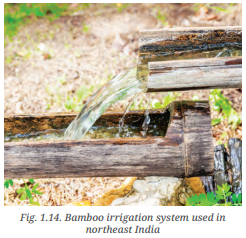
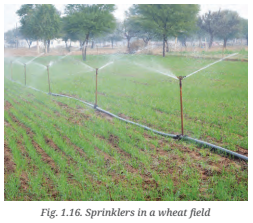
(a) Phad system
(b) Drip irrigation
(c) Trickle irrigation
(d) Bamboo drip irrigation
Answer:
(c) Trickle irrigation
Question 2.
In which part of India this system in used.
(a) South-West India
(b) North-Eastern India
(c) North-West India
(d) East-West India
Answer:
(b) North-Eastern India
Question 3.
Name the irrigation system you can seen in picture ‘B'.
(a) Drip irrigation
(b) Sprinklers
(c) Bamboo drip irrigation
(d) Both (a) and (b)
Answer:
(b) Sprinklers
Question 4.
This ‘B’ picture irrigation system works over crops like :
(a) Natural rain
(b) Artificial rain
(c) Pesticides
(d) None of above
Answer:
(b) Artificial rain
The Story of Indian Farming Class 7 Map Based Questions
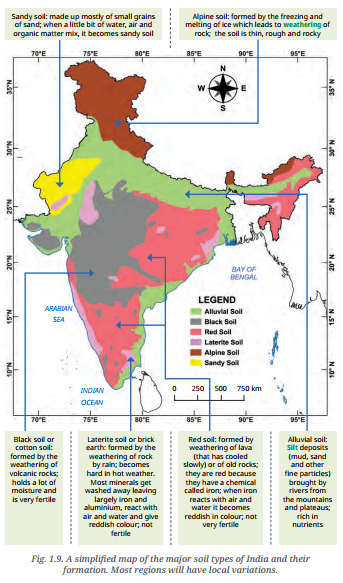
Question 1.
Name and label major soil types of India on map of India.
Answer:
(a) Alluvial Soil
(b) Black Soil
(c) Red Soil
(d) Laterite Soil
(e) Alpine Soil
(f) Sandy Soil.
Class 7 The Story of Indian Farming Extra Questions for Practice
MCQs
Question 1.
The ancient site ‘Mehrgarh’ shows evidence of the cultivation of which crops in the 7th millennium BCE?
a) Rice and corn
b) Barley and millets
c) Potato and tomato
d) Coffee and tea
Question 2.
Drip irrigation is also known as:
a) Flood irrigation
b) Trickle irrigation
c) Canal irrigation
d) Sprinkler irrigation
Question 3.
What is ‘mulching’?
a) A method to prevent soil erosion
b) A method of harvesting
c) A type of seed
d) A machine for threshing
Question 4.
In rural areas, what percentage of agricultural workers are women?
a) Less than 20%
b) About 50%
c) More than 75%
d) 10%
Question 5.
Which soil becomes hard in hot weather and is used to make bricks?
a) Alluvial soil
b) Laterite soil
c) Alpine soil
d) Black soil
Very Short Answer Type Questions
Question 1.
Name one environmental benefit of afforestation along riverbanks.
Question 2.
Give one example of an agroclimatic zone in India.
Question 3.
Name two traditional irrigation systems in India.
Question 4.
What is panchagavya?
Question 5.
Which animal is used in Gokrishi farming?
Short Answer Type Questions
Question 1.
Explain the difference between rainfed and irrigated agriculture.
Question 2.
Mention two challenges faced by farmers due to climate change.
Question 3.
How do modern irrigation methods help farmers in areas with low rainfall?
Question 4.
What are the main types of farming in India?
Long Answer Type Questions
Question 1.
Describe how traditional and modern farming practices are combined in sustainable agriculture. Include examples.
Question 2.
Explain the role of the government in supporting farmers, including schemes and market assistance.
Class 7 SST Extra Questions
More from Class 7
- Banks and the Magic of Finance Class 7 Extra Questions and Answers SST Part 2 Chapter 8
- Infrastructure: Engine of India’s Development Class 7 Extra Questions and Answers SST Part 2 Chapter 7
- The State, the Government, and You Class 7 Extra Questions and Answers SST Part 2 Chapter 6
- India, a Home to Many Class 7 Extra Questions and Answers SST Part 2 Chapter 5
- Turning Tides: 11th and 12th Centuries Class 7 Extra Questions and Answers SST Part 2 Chapter 4
- Empires and Kingdoms: 6th to 10th Centuries Class 7 Extra Questions and Answers SST Part 2 Chapter 3
More in Social Science
- Banks and the Magic of Finance Class 7 Extra Questions and Answers SST Part 2 Chapter 8
- Infrastructure: Engine of India’s Development Class 7 Extra Questions and Answers SST Part 2 Chapter 7
- The State, the Government, and You Class 7 Extra Questions and Answers SST Part 2 Chapter 6
- India, a Home to Many Class 7 Extra Questions and Answers SST Part 2 Chapter 5
- Turning Tides: 11th and 12th Centuries Class 7 Extra Questions and Answers SST Part 2 Chapter 4
- Empires and Kingdoms: 6th to 10th Centuries Class 7 Extra Questions and Answers SST Part 2 Chapter 3