Turning Tides 11th and 12th Centuries Class 7 Question Answer SST Part 2 Chapter 4
Turning Tides 11th and 12th Centuries Class 7 Questions and Answers
Class 7 SST Part 2 Chapter 4 Question Answer
The Big Questions (Page 97)
Question 1.
Why are the 11th and 12th centuries seen as a period of transition in Indian history?
Answer:
The 11th and 12th centuries were a period of transition in Indian history because this period moved India from the fragmented medieval landscape towards the centralized structures. Some major changes are as follows :
(a) Old regional kingdoms became weaker during this time.
(b) New powers rose in different parts of India.
(c) Foreign invasions increased from the north-west.
(d) Political control shifted from many small rulers to new rulers.
(e) Despite changes, Indian culture and traditions continued.
(f) Significant devotional movement within Hinduism gained momentum.
Question 2.
Which new powers emerged during this period? What were the essential features of their economic, military and administrative systems?
Answer:
The 18th-century decline of the Mughal Empire facilitated the rise of new regional powers, including the Marathas, Sikhs, Jats, Afghans, and the Nizams of Hyderabad, Nawabs of Bengal, and Mysore. These states featured decentralized administration, specialized standing armies, and reformed revenue systems (e.g., Maratha chauth) tailored to local economic conditions.
Key Features of New Powers :
New powers included the cholas who ruled Tamilnadu and expanded their territory into the parts of Karnataka and Andhara Pradesh, The hoysalas expanded across Karnataka , whilw the Kakatiyas governed much of Telangaba and Andhara Pradesh.
The ghurids established authority over Delhi and near by regions. The chahamanas controlled Rajasthan and Haryana, Paramaras rued Malwa, and the senas held power in Bengal. The eastern Gangas rules southward coastal areas into Kalinga and were one of the stable power.
The essential features of their :
- Military: Shifted away from feudal levies to trained standing armies, such as those in Mysore, which adopted European-style drills and weaponry. The ghurids were known for their fast- moving cavalry that helped them secure quick victories.
- Administration: New rulers often maintained existing local administrative structures while appointing new, loyal elites to high positions. The ghurids introduce a more centralized arrangements by giving officers temprorary land assignments in return for collecting revenue and providing military service. This approach later influenced the governing style in Delhi.
- Economy: Agriculture was the main source of income and many rulers supported irrigation works to increase productivity. Internal and overseas trade with regions such as china and southeast Asia also continued to grow, helped by active merchant guilds.
Class 7 Social Science Part 2 Chapter 4 Question Answer
Question 3.
What high accomplishments in art, architecture, literature, science, etc., do we come across during this period?
Answer:
The 17th century was a period marked by a shift towards empiricism, rationalism, and dramatic, emotional expression in the arts. This period witnessed remarkable achievements across many fields:
Science and Mathematics: Scholars like Bhaskaracharya made major contributions to mathematics and astronomy, writing works on Bijaganita (algebra), Lilavati (arithmetic), and Siddhantasiromani (celestial calculations).
Architecture and Art: Temples and forts displayed extraordinary craftsmanship, including intricately carved stone temples in Khajuraho, forts with impressive gateways built by the Kakatiyas and the Hoysala temples with detailed sculptures. The Jagannatha and Sun temples in Odisha also began construction during this time.
Literature and Philosophy: Writers and thinkers flourished. King Bhoja wrote extensively on governance, arts and poetry.
Someshvara III compiled an encyclopaedia covering many aspects of life. Saints like Ramanujacharya and Basava promoted devotion, ethical living and social reform, emphasising equality and personal spiritual practice.
Cultural Influence: Indian ideas spread abroad, shaping architecture and religious practices in Southeast Asia, exemplified by Angkor Wat in Cambodia.
Let’s Explore
Question 1.
Observe the sketch of the Khyber Pass (Fig.). (Page 100)
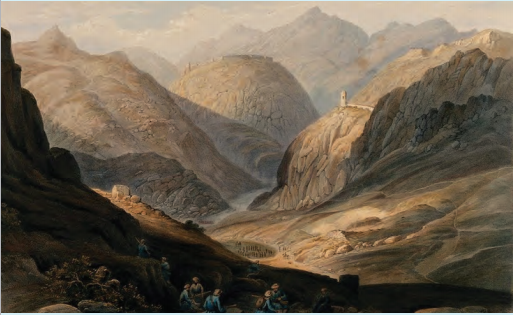
Fig. : The Khyber Pass, as painted by a British military officer in about 1847.
What kind of terrain does it depict?
Answer:
The sketch of the Khyber Pass depicts a mountainous or rugged, arid, broken hills terrain, narrow valleys and is one of the main mountain passes through the Hindu Kush range.
Question 2.
What advantages would it offer to an army trying to reach the Indus plains? But also, what dangers? (Page 100)
Answer:
Advantages and Dangers for an Army Advantages:
Natural Pathway: The pass offers a natural and the most direct overland route through a formidable mountain range, acting as a “gateway” from Central Asia/Afghanistan to the fertile Indus plains.
Feasible Movement: It provides the only relatively feasible path for a large army with horses, equipment, and supplies to travel across the high, rugged terrain, avoiding otherwise impassable mountains or vast deserts.
Acclimatization: Invading armies from Central Asia were often already adapted to the cold climate and mountainous warfare, which gave them an advantage over forces in the plains.
Dangers:
Chokepoint and Ambush: The narrow gorge, with cliffs rising 600-1,000 feet high, creates a critical chokepoint perfect for ambushes. Local tribal fighters could easily attack a large, strung-out column from commanding heights, then disappear into the hills.
Logistical Vulnerability: The confined space makes an army highly vulnerable to having its supply lines cut off.
Question 3.
Thinking of the caravans of traders that passed through the Khyber Pass for many- centuries, let’s ask the same questions about the advantages as well as dangers. (Page 100)
Answer:
Advantages and Dangers for Caravans of Traders
The advantages and dangers for trade caravans were similar to those for an army, albeit on a smaller scale:
Advantages:
- Established Trade Route: The pass was a vital segment of the ancient Silk Road.
- Commercial Access: It provided essential commercial access to the wealthy markets of the Indian subcontinent, facilitating significant cultural and economic exchange.
- Protection (Sometimes): Caravans could often secure safe passage by paying tolls or subsidies to the local tribes, which was a source of income for the inhabitants. Dangers:
- Robbery and Extortion: The primary danger was from the local, often warring, tribes who would frequently loot caravans if tolls were not paid or if they perceived weakness.
- Natural Obstacles: The difficult physical terrain made travel slow and arduous, requiring robust logistics (camels, etc.) and exposing traders to the elements.
Question 4.
In later centuries, the Somanatha temple was rebuilt and destroyed again several times; the existing temple was built in 1950 and inaugurated the next year by the then President of India, Rajendra Prasad. Why do you think it was decided to fund the construction entirely from public donations? (Page 103)
Answer:
The decision to fund the Somnath temple reconstruction entirely from public donations was made primarily based on the principle of secularism and the advice of Mahatma Gandhi, who believed that religious institutions should not be funded by the state.
The key reasons for this approach were:
- Adherence to Secular Principles: Prime Minister Jawaharlal Nehru was a strong proponent of a secular state and did not want the government to be officially involved in funding a religious project, which he viewed as potentially undermining the secular fabric of the new nation.
- Mahatma Gandhi’s Suggestion: When Sardar Vallabhbhai Patel and K.M. Munshi approached Mahatma Gandhi with the reconstruction plan, Gandhi suggested that the funds should be collected from the public to reflect the will and devotion of the general populace, rather than using government money.
- Symbol of Popular Sentiment: Funding through public donations made the temple’s reconstruction a national movement and a “national pledge” of the people, rather than a state project. This allowed ordinary Indians to contribute and associate with the renewal of a significant cultural and religious symbol.
Question 5.
In the painting, can you make out who is the king and who is the guru? What does the king’s posture and general attitude express? (Page 112)
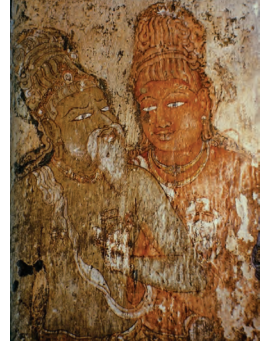
Fig. : An ancient painting of Rajendra Chola with his guru (at the BrihadTshvara temple)
Answer:
In the painting
The Guru-(spritual teacher) is shown The Rajendra Chola I shown standing behind the Guru
The King’s posture and attitude highly significant and express profound humility reverence and devotion towards the spritual master. The King’s respectful salution show that despite his immense power, he considered himself a humble desciple in the presence of his Guru.
Question 6.
Writing some 60 years after Bakhtiyar Khiljrs campaign through Bihar, the historian Minhaj al-Siraj JuzjanI, recorded in his Tabakat-i-Nasirl how Bakhtiyar’s forces captured a ‘fortress’ and “acquired great booty.” He adds, “The greater number of the inhabitants of that place were Brahmans, and all those Brahmans had their heads shaven; and they were all slain. There were a great number of books there. ... It was found that the whole of that fortress and city was a college, and in [their] tongue, they call a college bihar.” Remembering the meaning of vihara and noting that Nalanda was known in ancient inscriptions as ‘Nalanda Mahavihara’, can you find two more clues in the above passage to identify the ‘fortress’ near the Nalanda university? (Hint: Who do you think these ‘Brahmans’ actually were?) (Page 117)
Answer:
The first clue that the passage mentions is the “the greater number of the inhabitants of that place were Brahmans and all those Brahmans had their heads shaven”. Given that Nalanda was an enormous, world-renowned Buddhist monastery and university and Buddhist monks shave their heads are part of their monastic vows, these individuals referred to as “Brahmans” were in reality Buddhist monks and scholars. The term “Brahman” may have been used loosely by the foreign historian to refer to Hindu or religious scholars/priests in general, mistakenly applying it to the shaven-headed Buddhist monks who were the primary residents and victims of the attack.
Secondly “There were a great number of books in the place.” Nalanda Mahavihara was famous for its vast library and collections of manuscripts. These clues clearly point to the fact that the “fortress” mentioned was actually Nalanda University (Nalanda Mahavihara).
Question 7.
In KalyanI, Basavanna established an anubhava mandapa (literally, ‘pavilion of experience’), where men and women from every social, economic, religious or linguistic background, including saints and philosophers, could assemble to discuss all aspects of life, including moral values and religion.
Why, in your opinion, did Basava want people from all backgrounds to come together and exchange ideas? (Page 121)
Answer:
Basava’s establishment of the Anubhava Mandapa in KalyanI was a radical step rooted in the Virashaiva movement’s commitment to social reform and spiritual equality. His primary motivations were to dismantle the rigid caste system, promote the idea of a universal brotherhood/sisterhood, and challenge traditional religious hierarchies.
Question 8.
If something like an anubhava mandapa existed today, what important topics do you think people ought to discuss there? (Page 121)
Answer:
In a modern “anubhava mandapa,” reflecting Basavanna’s inclusive vision for open dialogue, people would likely discuss topics that bridge contemporary divides and address pressing global and local challenges.
- Key topics that people ought to discuss could include:
- Ethical and Moral Values in a Modern Context- social justice and equality, ethics of artificial intelligence etc.
- Social and Economic Challenges like mental health and well being,
- The Role of Belief and Spirituality
- Interfaith dialogue and religious pluralism.
Question 9.
What lessons can we draw from the anubhava mandapa spirit to create a just and civil society today? {Page 121)
Answer:
Lessons from the Anubhava Mandapa Spirit
Radical Inclusivity and Equality: The anubhava mandapa welcomed people from all social strata, economic backgrounds, religions, and genders as equals, challenging the rigid caste system and social hierarchies of its time.
Open and Respectful Dialogue: The mandapa served as a platform for saints, philosophers, and common people to engage in robust discussions on all aspects of , life, including moral values and religion, encouraging critical thinking and the free exchange of ideas.
Modern Application: Addressing complex issues like poverty, climate change, and social injustice requires multi-disciplinary collaboration and pragmatic, evidence-based solutions developed through collective effort. Encouraging participation from all affected communities ensures that solutions are relevant and actionable.
Think About It
Question 1.
We will meet later in this chapter the Persian scholar al-BIruni, who accompanied Mahmud in some of his campaigns. He wrote in his memoirs on India, “The Hindu Shahiya dynasty is now extinct, and of the whole house there is no longer the slightest remnant in existence. We must say that, in all their grandeur, they never slackened in the ardent desire of doing that which is good and right, that they were men of noble sentiment and noble bearing.
What conclusions can we draw from this remark by someone in. Mahmud’s entourage? (Page 101)
Answer:
From Al-Biruni’s remark, we can conclude that even though Mahmud’s forces defeated the Hindu Shahiya dynasty, the Persians accompanying him recognised the moral and ethical qualities of these rulers. The Shahiyas were seen as principled, just, and honourable leaders who upheld high standards of conduct. This shows that outsiders could acknowledge the nobility and virtue of a defeated people, separating military conquest from personal admiration of character.
Class 7 Turning Tides 11th and 12th Centuries Question Answer
Questions and Activities (Page 123-124)
Question 1.
Why is the period under consideration in this chapter regarded as a major transition in Indian history? Give two examples each of change and continuity from this period.
Answer:
The 11th and 12th centuries in Indian history are regarded as a major transition because they bridge the “early medieval” and “late medieval” periods, marking a shift from a world of fragmented regional kingdoms to the establishment of centralized Turkish rule in the north. Two clear changes during this period were the beginning of muslim rule in Delhi and the destructionof important centers of learning such as Nalanda.At the same time there was continuity in Indian society , with culture, literature, and scientific knowledge continuing to flourish, as seen in the works of scholers like Bhakaracharya, and trade, both with in India and with regions like chins and south east Asia, remained strong.
Question 2.
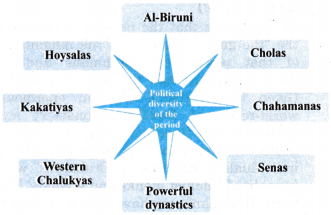
Observe in the previous chapter and draw a similar ‘star of dynasties’ gathering all or most of the dynasties that appear in this chapter.
Answer:
STAR OF DYNASTIES
Question 3.
Taking a map of the Subcontinent, draw a geographical tour that covers all or most dynasties in this chapter (you may draw inspiration from some of the ‘travels’ the chapter’s narration follows).
Answer:
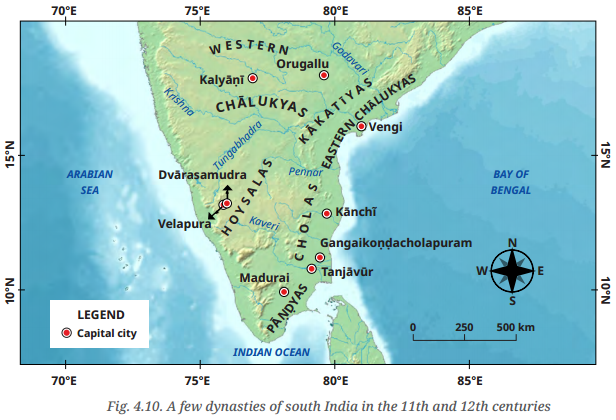
(a) Northwest (Entry Point): Show the Ghaznavid capital (Ghazna) and the path through the Hindu Shahi territory and the Khyber Pass into the Indus plains.
(b) North India (The Contested Zone): Highlight the territory of the Chahamanas (centred at Ajmer/Delhi) and the region of the Paramaras (centred at Dhara in Malwa). This zone would show the Ghurid advance post Tarain.
(c) East India: Mark the kingdom of the Senas (Bengal) and the Eastern Gangas (Odisha coast).
(d) The Deccan: Cover the area of the Kakatlyas (Warangal) and the rising power of the Hoysalas (Belur/Halebidu) in Karnataka.
(e) Far South: Dominantly feature the Chola Empire (centred at Thanjavur and Gangaikondacholapuram), illustrate their coastal control and potential naval reach into Southeast Asia (Shrlvijaya).
Question 4.
With the help of a map of India and Southeast Asia, can you calculate the approximate distance that Rajendra I’s fleet of ships had to navigate to reach their objective?
Answer:
(a) Rajendra I sailed from the Tamil Nadu coast.
(b) His fleet crossed the Bay of Bengal.
(c) It reached Southeast Asia (Srivijaya region).
(d) The distance was several thousand kilometres.
(e) This shows the strength of the Chola navy.
Question 5.
Match these two pairs:
Answer:
(a) - (iii)
(b) - (iv)
(c) - (v)
(d) - (i)
(e) - (ii)
Question 6.
Working in groups, compare t he dynasties in this chapter and in the preceding one; create a table to list the dynasties present in both, those that disappear from the preceding period, and those that appear in this chapter’s period.
Answer:
(a) Dynasties like Palas and Pratiharas disappear.
(b) Cholas, Hoysalas and Kakatiyas appear strongly.
(c) Some regions continue with new rulers.
(d) Political centres shift across regions.
(e) This shows change in power but continuity of governance.
Question 7.
Using the chapter and any additional reading, prepare a short note explaining (1) why centres of learning like Nalanda were important; (2) how their destruction may have affected education and culture in India.
Answer:
(a) Nalanda was a famous centre of education.
(b) Students came from India and other countries.
(c) Many subjects like religion, science and philosophy were taught.
(d) Its destruction caused loss of knowledge and libraries.
(e) Education and cultural exchange were badly affected.
Question 8.
Why do you think Mahmud of Ghazni carry out repeated raids from Afghanistan into India, while Muhammad Ghuri sought territorial expansion into India and long-term control? Write a short note on how their motives shaped the outcomes of their campaigns.
Answer:
Mahmud of Ghazni conducted approximately 17 raids between 1000 and 1027 CE. His approach was characterized by “hit-and-run” tactics rather than permanent occupation.
Motives: His primary motivation was economic—the acquisition of wealth to finance his vast Central Asian empire and maintain a professional standing army. He targeted wealthy temple towns like Somnath and Mathura because they were depositories of enormous riches. Religion served as a secondary motive to legitimize his raids and earn prestige in the Islamic world as an “idol- breaker”.
Outcomes: His campaigns drained India’s resources and weakened the military and economic strength of northern kingdoms like the Hindu Shahis. However, he did not establish a lasting administrative presence in India, apart from annexing regions like Punjab and Multan to serve as strategic bases for further raids.
Muhammad Ghori (12th Century)
Muhammad Ghori’s invasions in the late 12th century were fundamentally different in nature, focusing on territorial conquest and the establishment of a state.
Motives: Ghori sought to establish a permanent Islamic empire in India. His ambitions in Central Asia were checked by the powerful Khwarizmian Empire, prompting him to look eastward for expansion. Unlike Mahmud, he was a “far-seeing statesman” who prioritized long-term political control over immediate plunder.
Outcomes: His decisive victory against Prithviraj Chauhan in the Second Battle of Tarain (1192) broke the back of Rajput resistance and laid the foundation for the Delhi Sultanate. His campaigns resulted in the introduction of a new administrative and revenue system (such as the iqta system) and a lasting Indo-Islamic cultural synthesis.
Exploring Society India and Beyond Class 7 Solutions
More from Class 7
- Banks and the Magic of Finance Class 7 Extra Questions and Answers SST Part 2 Chapter 8
- Infrastructure: Engine of India’s Development Class 7 Extra Questions and Answers SST Part 2 Chapter 7
- The State, the Government, and You Class 7 Extra Questions and Answers SST Part 2 Chapter 6
- India, a Home to Many Class 7 Extra Questions and Answers SST Part 2 Chapter 5
- Turning Tides: 11th and 12th Centuries Class 7 Extra Questions and Answers SST Part 2 Chapter 4
- Empires and Kingdoms: 6th to 10th Centuries Class 7 Extra Questions and Answers SST Part 2 Chapter 3
More in Social Science
- Banks and the Magic of Finance Class 7 Extra Questions and Answers SST Part 2 Chapter 8
- Infrastructure: Engine of India’s Development Class 7 Extra Questions and Answers SST Part 2 Chapter 7
- The State, the Government, and You Class 7 Extra Questions and Answers SST Part 2 Chapter 6
- India, a Home to Many Class 7 Extra Questions and Answers SST Part 2 Chapter 5
- Turning Tides: 11th and 12th Centuries Class 7 Extra Questions and Answers SST Part 2 Chapter 4
- Empires and Kingdoms: 6th to 10th Centuries Class 7 Extra Questions and Answers SST Part 2 Chapter 3