The State the Government and You Class 7 Question Answer SST Part 2 Chapter 6
The State the Government and You Class 7 Questions and Answers
Class 7 SST Part 2 Chapter 6 Question Answer
The Big Questions (Page 143)
Question 1.
What is the difference between a state and a government?
Answer:
Aspect | State | Government |
Definition | A state is a permanent political entity with a defined territory, population, government, and sovereignty. | Government is the machinery or agency through which the state expresses and enforces its policies and laws. |
Permanence | Permanent; it continues despite changes in government. | Temporary; changes with elections or other political processes. |
Composition | Includes territory, population, government, and sovereignty. | Only the group of people who administer and run the state affairs at a given time. |
Sovereignty | Has sovereignty (supreme power within its territory). | Does not have sovereignty; derives power from the state. |
Functions | Maintains law and order, plans and develops the society, protects citizens. | Executes policies, enforces laws, manages day-to-day affairs. |
Examples | India, USA, UK (as countries) | The Central Government of India, State Governments, local governments. |
Question 2.
What is the difference between a democracy and a republic? What makes India a democratic republic?
Answer:
Democracy | Republic |
A form of government where people have power | A political system with an elected head of state |
Majority rule and individual rights | Rule of law and protection of individual rights |
Decisions made through voting | Decision-making through elected representatives |
Citizens participate in decision-making | Citizens elect representatives to make decisions |
The following points make India a democratic republic:
(a) People elect their leaders, from local bodies to the Parliament — this makes India a democracy.
(b) The President is an indirectly elected head of state, not a hereditary monarch.
(c) The Constitution is supreme, guaranteeing rights, equality and justice for all citizens and ensuring that leaders rule according to law.
Class 7 Social Science Part 2 Chapter 6 Question Answer
Question 3.
How do citizens engage with the government in day-to-day life? How can one make government work for the people?
Answer:
Citizens engage with government daily through voting, paying taxes, using public services (like e-services, transport), providing feedback via apps/petitions, joining community groups, and exercising rights like the RTI; to make government work for them. People can make work the government work for them in the following ways:
- Using tools like the Right to Information (RTI) to ensure transparency and accountability in public work. Citizens can ak the government for details about its policies, decisions, and actions of public interest.
- Fostering a cooperative relationship between citizens and the government, especially at the grassroots level.
- Bringing innovative ideas and perspectives to solve community problems, such as waste management or local infrastructure needs.
- Through voting, people can elect good candidates and reject those who do not work in the public interest.
- Citizens can write to local representatives, MLAs, MPs, or ministers to urge them to take action on important issues.
Let's Remember
Question 1.
We learned about democratic, monarchic, theocratic, dictatorial, and oligarchic forms of government, and how they function differently. Can you recount some of the differences? (Page 144)
Answer:
There are different types of government in different parts of the world. Each system differs in how leaders are chosen, how decisions are made, and how much freedom people enjoy.
Forms of government-
- Democratic (People’s Rule): Governments are chosen through elections, and representatives are accountable to the citizens. It emphasizes popular sovereignty and constitutional law.
- Monarchic (King/Queen): Power is inherited within a royal family. It is based on birthright, where a single ruler is head of state.
- Theocratic (Religious Rule): Led by religious leaders or officials, where authority is derived from religious law and doctrine.
- Dictatorial (One Leader): An authoritarian system where a single person has absolute power, often seized by force or through manipulated elections, rather than hereditary right.
- Oligarchic (Small Group): A country governed by a few individuals or elites, typically based on wealth, military power, or family influence.
Question 2.
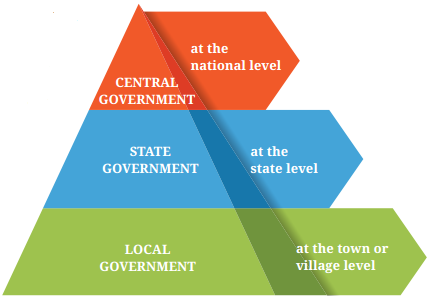
Do you remember this image from Grade 6, Chapter 10? It represents the three tiers of Government in India. Why do we have these levels of Government in India? Can’t we have just one level to do fulfil all the functions? Let us explore this further. (Page 161)
Answer:
(a) Yes, I remember this image. India has three tiers of government—Central, State, and Local.
(b) India is a massive country with a population larger than many continents combined. A single level of government cannot effectively monitor or manage every village, town, and state.
- One level of government may lead to over concentration of power, fail to do justice to all regions and could even become dictatorial in nature.
- Local problems need local solutions, so issues like water, sanitation, and roads must be handled by local and state governments— not only by the central government.
- India is too large and diverse for a single government to manage the needs of all states, regions, languages and communities.
- Sharing power prevents misuse and strengthens democracy, ensuring that all levels work together and no single authority becomes too powerful.
(c) No, we cannot have just one level of government to fulfil all the functions because the country is geographically very large, consisting of more than 140 crore people, thousands of towns and villages, one single government cannot understand or manage the needs of every region. Sharing power among different levels of government makes administration efficient and strengthens democracy.
Let’s Explore
Question 1.
Make lists of different government departments you are familiar with, or whose names you may have seen on boards around your home or on your way to school. What functions do you think they perform? (Page 148)
Answer:
Common Government Departments and Functions:
- Department of Education (Directorate of Education): Manages government schools, sets curricula, provides mid-day meals, and ensures literacy.
- Department of Health and Family Welfare: Operates government hospital's, dispensaries, and rural health centers (Anganwadi); manages vaccination drives.
- Public Works Department (PWD): Responsible for the construction and maintenance of public roads, bridges, and government building infrastructure.
- Department of Transport: Manages public bus services, issues driving licenses, and regulates traffic.
- Department of Police (Home Affairs):
- Maintains law and order, ensures public safety, and operates local police stations.
- Department of Agriculture: Supports farmers with fertilizers, agricultural research, and irrigation resources.
- Department of Water Supply/Irrigation: Ensures the supply of clean drinking water to households and manages irrigation.
- Department of Environment and Forests: Manages parks, gardens, and protects green spaces in the city.
- Department of Municipal Services/ Urban Development: Handles sanitation, waste management, and street lighting. These departments work to ensure basic facilities and security for the public.
Question 2.
Collect editorials from a few newspapers. Read them in small groups. Identify the topics on which they have opinions. How many are about government policies? (Page 160)
Answer:
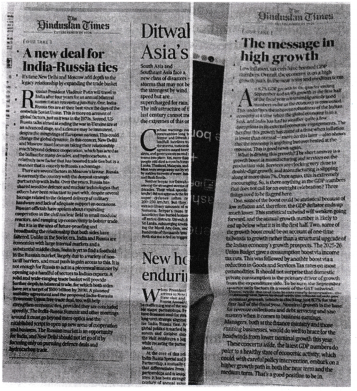
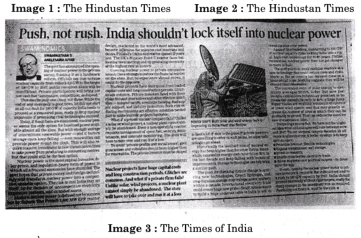
All these images are of cuttings from newspapers regarding government policies:
- Image 1 of The Hindustan Times is regarding Foreign Policy.
- Image 2 of The Hindustan Times is regarding Economic Policy.
- Image 3 of The Times of India is regarding Nuclear Power Policy.
Question 3.
What might be the reasons that decisions regarding local concerns should be taken locally to the extent possible? (Page 162)
Answer:
Decisions on local concerns should be made locally because local authorities and residents understand the unique needs, priorities, and context of their area better, leading to more relevant, acceptable, and effective solutions, fostering greater community engagement and faster, tailored responses to issues like infrastructure, resources, and environment. This promotes local ownership, accountability, and sustainability by aligning policies with community values and benefiting the local economy and environment directly.
Question 4.
List five major achievements of our country in improving the lives of ordinary people in your village, town or city. Which level of government made this possible and how? (Page 165)
Answer:
Five Major Achievements & Government Roles:
(a) Increased Literacy & Education Access
(b) Improved Infrastructure (Roads, Telecom): Union Govt
(c) Strengthened Democracy & Rights
(d) Healthcare Expansion (Primary Care)
(e) Poverty Alleviation & Food Security
Question 5.
List five problems that ordinary people face frequently. At which level of government should these be addressed and how? (Page 165)
Answer:
Five Frequent Problems & Government Roles:
(a) Inconsistent Quality of Public Services (Health/Education): State & Local Govts often lack resources/capacity; better funding, monitoring by Union Govt, and local accountability are key.
(b) Environmental Pollution (Air/ Water): Cross-jurisdictional issue. Union Govt (national policies), State Govts (implementation, pollution control boards), and Local Bodies (waste management) need integrated action.
(c) Unemployment & Skill Gaps: Primarily State & Local Govts (local industry, skill
centers), supported by Union Govt (skill development schemes), need to align education with job market needs.
(d) Access to Justice & Redressal: Union Govt (legal aid, judicial reforms) & State Govts (police, local courts) must improve accessibility, transparency, and speed, as suggested by Constitution Day campaigns.
(e) Urban Infrastructure Strain (Water, Sanitation, Transport): Local Bodies (Municipalities/Panchayats) are primary actors, needing strong State Govt support for planning/funding and Union Govt schemes (Swachh Bharat, Smart Cities).
Think About It
Question 1.
If a streetlamp in your neighbourhood is broken, who would you contact to fix it? If a village road needs to be repaired, would the local people reach out to the Central Government? (Page 162)
Answer:
If a streetlamp in your neighbourhood is broken, we should contact Local Municipal Corporation, Ward Office, or Municipal Councilor. In cities and towns, services are handled by the urban Local government and in villages it is handled by the Gram panchayat.
No, local people would not directly reach out to the Central Government for a local village road repair. They should contact the Gram Panchayat (Village Council), specifically the Sarpanch. The Gram Panchayat is the local self-government responsible for maintaining village-level infrastructure, including roads, sanitation, and streetlights. While the Central Government provides funds for major initiatives like the Pradhan Mantri Gram Sadak Yojana (PMGSY), the maintenance and repairs are handled at the state or local level.
Don't Miss Out (Page 151)
In 1782, as the American War of Independence was ending, an officer suggested George Washington become king of America. Washington firmly refused, saying it would harm the country. He believed only in government by the people under a constitution. He became the first President of the United States in 1789. According to Kautilya (author of Arthashastra), the king must follow Raja Dharma and have good governance.
He should ensure law and order. Without government, society becomes chaotic with the powerful eating the weak (Matsya nyaya — “big fish swallow smaller ones”)

Fig. 6.9. ‘Matsya nyaya — in the absence of law and order, the big fish swallow the smaller ones.
Don't Miss Out (Page 159)
In 1970, Kerala Government planned a hydroelectric project in Silent Valley. It would have submerged untouched evergreen forests and destroyed biodiversity. Many NGOs mobilised public opinion against the dam. Hundreds of scientists, environmentalists, writers, teachers, and villagers joined. In 1983, Central Government cancelled the project. In 1985, Silent Valley was declared a National Park.
Don’T Miss Out (Page 162)
One of the Directive Principles stated: “The state shall take steps to organise village panchayats and endow them with such powers and authority as may be necessary to enable them to function as units of self-government.”
Don't Miss Out (Page 163)
Gandhi was a strong advocate of decentralisation. He believed in largely self-sufficient village governments called gram swaraj. He stated: “My idea of village swaraj is that it is a complete republic, independent of its neighbours for its own vital wants, and yet interdependent for many others in which dependence is a necessity.”
Class 7 The State the Government and You Question Answer
Questions and Activities (Page 166-167)
Question 1.
“Every democracy is a republic.” Is this statement true or false? Explain.
Answer:
The statement, “Every democracy is a republic,” is False. The two terms describe different aspects of a government, and a country can be a democratic without being a ‘ republic. The statement is false because-The core difference is the nature of the head of state:
- A democracy can have a monarch as a ceremonial head of state, provided that the actual governing power is held by an elected body and leaders are chosen by the people through free elections. These systems are called constitutional monarchies or parliamentary monarchies.
- A republic explicitly prohibits a hereditary monarch as the head of state; the highest leader is a member of the public, typically a president, chosen through some form of election.
Question 2.
Give two reasons why decentralisation is important in India.
Answer:
Decentralization is important in India primarily because it brings governance closer to the local population and promotes direct democratic participation.
Reasons why decentralization is important in India:
Effective Governance and Service Delivery: Local governments have a better understanding of the specific problems, needs, and priorities of their localities compared to central or state governments. This proximity allows for the tailoring of development programs and public services (like sanitation, water supply, and education) to local conditions, leading to more efficient and effective implementation and resource utilization.
Strengthening Grassroots Democracy and Inclusion: Decentralization, institutionalized through the 73rd and 74th Constitutional Amendments, provides a platform for citizens to participate directly in the decision-making process through institutions like Gram Sabhas (village assemblies) and Ward Committees. This process empowers marginalized sections of society, including women and Scheduled Castes/Tribes, by reserving seats for them in local bodies, thereby fostering a more inclusive and representative democracy at the grassroots level.
Question 3.
Imagine you are part of your school’s student council. The council works like a mini-parliament — it has members elected by students, debates issues and makes decisions. In this context, do you think it would be better if only the council president makes all the decisions or if power is to be shared among all members?
- Should the student council have the power to make rules about the food you eat, or the language you speak?
- What can go wrong if the student council is the most powerful body in your school and no one questions its decisions?
Answer:
Depends on what kind of school you are in, because in many schools students’ perception is not given enough importance, you are a dummy even in the council. Luckily in our school I got a chance and I elected as a part of student’s council. Being a part of the Students’ Council is a great opportunity to contribute to the school community. According to my opinion its better to share the power or decisions among other students as It allows students to voice their opinions, represent their peers, and participate in decision-making processes that affect their school life.
- Yes, the council should have a say in canteen menus, healthier options, and food-related events, representing student interests for better choices.
- No, basic language use (like the official school language) is usually a core policy set by administration, not the council.
The council can promote multilingualism or cultural language events, but not ban languages.
Question 4.
Think about these real-life situations in 4 relation to India’s democracy:
(a) Should the Parliament be the most powerful institution in the country? Why or why not?
(b) Should the Parliament have the power to make any law it wants, even if it affects your rights?
(c) What could go wrong if lawmaking has no limits? Can it lead to unfair or unjust laws?
(d) Who is more powerful in India, the Parliament or the Supreme Court? Give your reasons.
Answer:
(a) India’s democratic framework ensures that while Parliament is a powerful and central institution, it operates within a careful system of checks and balances where the Constitution reigns supreme, not any single institution. This system safeguards individual liberty and prevents the abuse of power, which is essential for a robust and functioning democracy.
(b) In India’s democracy, the Parliament does not have the power to make any law it wants. Its power is limited by the Constitution, which guarantees fundamental rights to all citizens.
(c) In a democracy like India, lawmaking is governed by a system of checks and balances. If lawmaking had no limits, it could lead to several critical failures that undermine the democratic fabric:
- Risk of Unfair or Unjust Laws: Without limits, laws could be passed that are inherently biased or discriminatory.
- Erosion of Fundamental Rights: Limits on lawmaking, specifically the Basic Structure Doctrine, prevent the government from enacting laws that violate citizens’ fundamental rights.
- Destruction of Checks and Balances: Unlimited lawmaking would dismantle the separation of powers between the Legislature, Executive, and Judiciary.
- Societal and Federal Instability: Laws passed without considering the diverse regional interests of India can lead to significant tensions between the Center and States.
(d) In the Indian democratic system, neither the Parliament nor the Supreme Court is “more powerful” in an absolute sense. Instead, India follows the principle of Constitutional Supremacy, where the Constitution is the ultimate source of power for all branches of government. Power is distributed through a delicate system of checks and balances:
Why the Parliament is Powerful:
The Parliament represents the “will of the people” as its members are directly elected.
- Lawmaking Authority: It has the primary power to enact, amend, or repeal laws and a large portion of the Constitution.
- Control over the Judiciary: Parliament decides the number of judges in the Supreme Court and can remove them through a complex process called impeachment for proved misbehavior or incapacity.
- Response to Judgments: If the Supreme Court delivers a judgment the government disagrees with, Parliament can amend the law to change its legal basis (e.g., the 1986 response to the Shah Bano case).
Why the Supreme Court is Powerful:
The Supreme Court acts as the “Guardian of the Constitution” and protector of fundamental rights.
- Judicial Review: It has the power to declare any law or constitutional amendment unconstitutional if it violates the Constitution.
- Basic Structure Doctrine: Established in the 1973 Kesavananda Bharati case, this doctrine prevents Parliament from amending the “core” or basic features of the Constitution (like secularism or democracy), even with a unanimous vote.
- Collegium System: The judiciary effectively appoints its own judges through the Collegium, limiting the executive and legislative influence on judicial appointments.
The Final Balance:
The relationship is a “middle path” between British Parliamentary Sovereignty and American Judicial Supremacy.
- The Parliament can pass any law, but only within the “four walls” of the Constitution.
- The Supreme Court can strike down laws, but it cannot “legislate” or create laws itself, which remains the exclusive domain of the people’s representatives.
Ultimately, for the democracy to function, both must operate within their respective spheres of influence with mutual respect.
Question 5.
Ask your parents / guardians how they engaged with the government over the past year. Make a list and classify the items based on the level of government they had to work with. What challenges did they face?
Answer:
In a democracy like India, citizens interact with different levels of government for various everyday needs and services. Some works are done efficiently but most of the times people have to face many challenges.
Central Government: My parents interacted with the central government for services such as updating Aadhaar details, applying for a passport, using the banking system, and other related tasks. While some processes were convenient, they also faced challenges such as technical issues on online portals, long waiting times at Aadhaar centres, slow and inefficient banking procedures, and confusion about the required documents.
State Government: With the state government, my parents engaged in tasks such as making and renewing a driving licence at the RTO, getting a new electricity connection for our new house, school admissions, and other related services. The difficulties they encountered indued long queues, repeated visits due to incomplete paperwork, and delays in receiving approvals or corrections.
Local Govenment: At the local level, my parents dealt with responsibilities such as paying property tax, obtaining a birth certificate, managing garbage collection, and requesting sanitation services. Challenges at this level included slow responses from municipal departments, lack of clear information, and delays in resolving complaints.
Challenges Faced:
- Bureaucratic Delays: Long wait times for processing applications for documents like passports or licences.
- Digital Hurdles: Difficulty navigating online portals, especially when websites were slow or user-unfriendly.
- Multiple Visits: The need for physical, in-person visits to government offices for verification despite online options.
- Lack of Information: Unclear instructions regarding the necessary documents, leading to confusion and repeated attempts.
This exercise shows that most personal engagements occur at the local level for services, while financial and identification tasks occur at the state and national levels.
Exploring Society India and Beyond Class 7 Solutions
More from Class 7
- Banks and the Magic of Finance Class 7 Extra Questions and Answers SST Part 2 Chapter 8
- Infrastructure: Engine of India’s Development Class 7 Extra Questions and Answers SST Part 2 Chapter 7
- The State, the Government, and You Class 7 Extra Questions and Answers SST Part 2 Chapter 6
- India, a Home to Many Class 7 Extra Questions and Answers SST Part 2 Chapter 5
- Turning Tides: 11th and 12th Centuries Class 7 Extra Questions and Answers SST Part 2 Chapter 4
- Empires and Kingdoms: 6th to 10th Centuries Class 7 Extra Questions and Answers SST Part 2 Chapter 3
More in Social Science
- Banks and the Magic of Finance Class 7 Extra Questions and Answers SST Part 2 Chapter 8
- Infrastructure: Engine of India’s Development Class 7 Extra Questions and Answers SST Part 2 Chapter 7
- The State, the Government, and You Class 7 Extra Questions and Answers SST Part 2 Chapter 6
- India, a Home to Many Class 7 Extra Questions and Answers SST Part 2 Chapter 5
- Turning Tides: 11th and 12th Centuries Class 7 Extra Questions and Answers SST Part 2 Chapter 4
- Empires and Kingdoms: 6th to 10th Centuries Class 7 Extra Questions and Answers SST Part 2 Chapter 3