The Rise of Empires Class 7 Question Answer SST Chapter 5
Class 7 SST Chapter 5 The Rise of Empires Question Answer
The Rise of Empires Class 7 Questions and Answers
THE BIG QUESTIONS (Page 83)
Question 1.
What is an empire?
Answer:
An empire: It is a collection of smaller kingdoms or territories over which a powerful ruler takes control over these territories.
In view of terminology
- The word ‘empire’ comes from the Latin ‘imperium’, which means ‘ supreme Power’.
Question 2.
How did Empires rise and shape Indian civilisation?
Answer:
Empires rose in the following manners:
- To deploy the trained armies to win and control the neighbouring Kingdoms.
- To build fortified settlements.
- To wage war against neighbouring territories.
- To try to control rivers and other precious resources.
How Empires shaped Indian Civilisation:
- By maintaining law and order
- By making new laws.
- By issuing currencies
- By regulating trades
- By controlling and regulating resources
- By maintaining communication networks
- By encouraging art, literature etc.
Class 7 Social Science Chapter 5 The Rise of Empires Question Answer
Question 3.
What factors facilitated the transition from kingdoms to Empires?
Answer:
The following factors facilitated the transition from kingdoms to empires:
- Kingdoms had resource-rich fertile plains (Ganga plains).
- Kingdoms had abundant forests for timber and elephants.
- Kingdoms had hilly regions with iron-ores and other minerals.
All these factors were equally responsible for the transition from the kingdoms to empires but the use of iron with the help of technology would be the most important factor in bringing a bigger change.
Also, a clear vision of Kautilya about empires would indeed have made the empires more consolidated- economically, politically, and socially.
Question 4.
What was life like from the 6th to the 2nd century BCE?
Answer:
Life from the 6th to 2nd century BCE was fine economy-wise, administrative-wise, military-wise, etc.
The following points would help to explain what the life was:
- The cities of these periods were centres of governance and commerce, places, public buildings and well-planned streets.
- Flourished agriculture- 2 crops sown in a year. Granaries were well-stocked. So farmers were safe with regard to food.
- Well-planned cities.
- Good communication networks.
LET’S EXPLORE (Page 89)
Question 1.
Empires extended over vast areas and had diverse people with differing languages, customs and cultures. How do you think the emperors made sure that they lived in harmony? Discuss in groups and share your thoughts with the class.
Answer:
We think the emperors made sure that they lived in harmony by the following methods:
- By the establishment of efficient administrative systems.
- By giving respect to all customs and religions.
- By controlling and maintaining trade routes for commercial activities.
- By making laws and maintaining law and order in their empires
Many other things also made sure such as encouraging welfare activities, giving protections to all etc. they could live in harmony.
Question 2.
Looking at the many challenges involved in managing an empire, why should a king be so keen to expand his kingdom into an empire and become an emperor? Here are a few possible answers; see if you can think of a few more:
Answer:
- An ambition to ‘rule the entire world’: That was for controlling large territories and ensuring that they would be remembered for posterity.
- A wish to bring large areas under control: That was for gaining access to their resources to build economic and military strength;
- A desire for great wealth: That was essential for himself and the empire.
Few more answers:
- A desire for name and fame.
- A wish to spread culture and religion.
- An ambition to show the power
LET’S EXPLORE (Page 91)
Question 1.
Warfare apart, what other methods do you think the rulers might have used to expand their empires? Pen your ideas and share them with your class.
Answer:
Warfare apart, the following other methods we think the rulers might have used to expand their empires:
- They used to get the kingdoms ready to make a treaty.
- They used to get an alliance through marriages.
- They used to encourage the smaller kingdoms through their economic prosperity.
LET’S EXPLORE (Page 93)
Question 1.
Observe the map of the trade routes. Identify geographical features that helped the traders travel across the Subcontinent.
Answer:
After observing the map of the trade routes, some geographical features are as follows that helped the traders travel across the subcontinent:
- Mountain passes
- Mainly the rivers
- Natural ports on the eastern and western coast.
- Plateaus
Question 2.
What modes of transport on those roads do you think were available at the time?
Answer:
The following modes of transport on those roads we think were available at the time:
- Carts-Oxen or Bulls
- Horses or Chariots
- Elephants
LET’S EXPLORE (Page 94)
Question 1.
Take a close look at the panel given above. How many types of weapons can you identify? What different uses of iron can you make out?
Answer:
Take a close look at the panel given above. Following types of weapons we identify:
- Swords, Bows and arrows, Shields, Spears. We can make out iron in the following uses:
- For making doors, gates etc.
- For making chains or hooks for animals.
- For making other tools such as axes, blades etc.
Question 2.
In the left part of the panel, a parasol (chhattra) is kept over the casket containing the Buddha’s relics. What do you think this was done?
Answer:
A parasol (Chhattra) is kept over the casket containing Buddha’s relics in the left part of the panel.
- It is a great sign of great honor and respect;
- It shows the royal status.
- It is very sacred because it is directly connected to the Buddha’s spiritual power.
- It realises the presence of Buddha in the present world.
THINK ABOUT IT (Page 97)
Question 1.
Why do you think Alfexander wanted to rule over the entire world? What would he have gained from it?
Answer:
We think Alexander wanted to rule over the entire world because of the following reasons:
- By controlling the wealth and resources of other regions.
- By showing himself the most powerful king.
- By spreading Greek culture.
He would have gained the following things from it:
- He must have earned a name and fame.
- He must have earned more power.
- He must have earned a good amount of wealth and resources
LET’S EXPLORE (Page 97)
Question 1.
When, after the battle, Alexander asked Porus how he wished to be treated, Porus answered, “Like a King.” Alexander then left Porus at the head of his kingdom, as satrap. With the help of your teachers, find more details on the battle between Porus and Alexander. Enact a play of this battle scene using your imagination in addition to what you have discovered.
Answer:
Some more details about the battle between Porus and Alexander are as follows:
- The battle was fought in 236 BCE.
- It was fought at the banks of the Hydaspes River (Presently known as Jhelum River).
- Alexander had the Great’s Army of approximately 40,000 infantry and 5000-7000 cavalry.
- This battle causes heavy loss to the Porus’s forces. About 20,000 infantry and 3,000 cavalry were killed.
- Porus fought the battle with bravery but was defeated in the battle.
- Alexander was impressed by Porus’s bravery and his good leadership in the battle.
A PLAY
SCENE 1:
Narrator: The narrator explains the scene when Alexander’s army is on the way to attack the Porus.
A soldier from Porus’s Army: “Alexander’s army has approached the Hydaspes River.
Alexander addresses to his army: We shall cross this river under the cover of night. As night fell Alexander began to cross the river and finally crossed.
SCENE 2:
Narrator: Alexander and Porus were face to face on the battlefield
Porus arranges his army in the following manner :
- Cavalry on both the blanks.
- Chariot at the front.
- Infantry in the Centre.
For a while, Alexander’s forces are confused but defeated at the end.
Porus: Hold your positions. Let the
elephants lead the charge.
Alexander: Target the enemy.
SCENE 3:
Narrator: “After defeating Porus, Porus was wounded but he stands boldly like a warrior.
Alexander: You fought bravely, Porus. How should I treat you?
Porus: “Like a king.”
Narrator: “The word of Porus impressed Alexander. He gave him a satrap.
THINK ABOUT IT (Page 103)
Question 1.
Kautilya says, “A king shall increase his power by promoting the welfare of his people, for power conies from the countryside which is the source of all economic activity. [The king] shall show special favours to those in the countryside who do things which benefit the people, such as building ‘ embankments or road bridges, beautifying villages, or helping to protect them.”
Answer:
To promote the welfare of the people and to do things benefiting the people, the following things have been suggested by Kautilya in his book, ‘Arthashastra’.
- Building reservoirs: These will help in ensuring a continuous water supply for agriculture.
- Hoad and Bridge Construction: Road is essential for smooth economic activities and necessary for improving trade. Bridges keep us safe.
- Beautifying villages: Village beautification is also necessary for providing the people with a comfortable life. That can only be possible when they have been provided with the basic infrastructure.
Question 2.
Why do you think it was important to take special care of the countryside? (Hint: Think back to what you have learnt at the beginning of this chapter)
Answer:
I think it is important for the following reasons to take special care of the countryside:
- They provide food security to the whole kingdom or empire and help in engaging in other economic activities.
- They play an important role in bringing political stability. They remain loyal if they are provided the basic resources to them for their survival.
- They maintain communal harmony.
In essence, they should need special care in constructing roads and bridges, and promoting welfare activities so that the lifestyle of the village can be made qualitative and the villages can be part of the beautification.
LET’S EXPLORE (Page 103)
Question 1.
Organise a group discussion in your class and compare the features of Kautilya’s idea of an empire with a . modern nation.
Answer:
The features comparing Kautilya’s idea of an empire with a modern nation are given below:
| Features of Kautilya’s Idea of Empire | Features of Modern Nations |
| 1.Monarchical form of Governance. | 1. Democratic form of Governance. |
| 2. The mode of system in fashion was hereditary. | 2. The mode of the system is based on fair election to elect representatives. |
| 3. The law-making body was a king or emperor. His words were the law. | 3. The parliament is a law-making body. |
| 4. Minimal participation of citizens in the state matter. | 4. Active participation of citizens in state affairs. |
| 5. The citizens’ rights are defined by the king. | 5. Rights are defined by a constitution such as equality before law, left. |
THINK ABOUT IT (Page 104)
Question 1.
Ashoka, in his edicts, tells the story of the Kalinga war. He could have chosen not to mention it and maintain his image as a peaceful, benevolent king for future generations. Why do you think he admitted to this destructive war?
Answer:
We think he admitted to this destructive war because:
- This war causes a great loss of life. Over 1 lakh people were killed and many others wounded. That’s why he regretted this great loss.
- This war taught him a lesson, “war never . brings prosperity to a nation”. It can only bring the destruction.
THINK ABOUT IT (Page 107)
Question 1.
Ashoka details instructions on the conduct of his officials and mentions ways to ensure that they practised ^ fairness in one of his edicts. Read the translation below and share your thoughts on whether those ways would have been successful in helping manage his empire and how.
“By order of the Beloved of the Gods — the officers and city magistrates [...] are to be instructed thus:
[...] You are in charge of many thousands of living beings. You should gain the affection of men. All men are my children, and just as I desire for my children that they should obtain welfare and happiness both in this world.and the next, the same do I desire for all men. [...] You should strive to practice impartiality. [...] The root of all this is to be even-tempered and not rash in your work. [...] This inscription has been engraved here in order that the city magistrates should at all times see to it that men are never imprisoned or tortured without good reason. [...] And for this purpose, I shall send out on tour every five years, an officer who is not severe Or harsh; who, having investigated this matter..., shall see that they carry out my instructions.”
Answer:
The ways which would have been successful in helping manage his empire in the following ways:
By an approach of affection:
- That is indeed a good way to bring peace and harmony to a nation.
- That is good to avoid such events which may cause a huge loss
- That is good for the welfare and happiness of the society or nation.
By an approach of supervision:
- That is also a good way to examine time to time about the impartiality of the public.
- That can give relief to the men who are tortured without any good reason.
LET’S EXPLORE (Page 109)
Question 1.
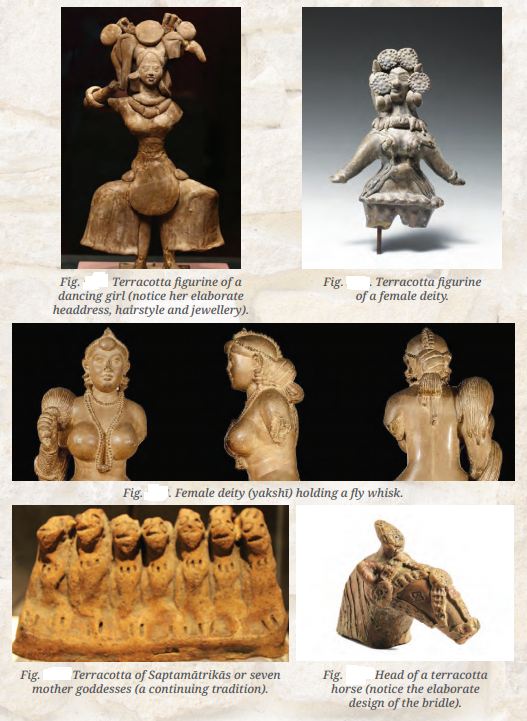
Wear the hat of a historian. Look carefully at the artefacts presented on the spread on the next page. What conclusions can you draw about people and life during the Mauryan era?
Some Contributions of the Mauryas
Life and people
Answer:
We draw the following conclusions about the people and life during the Mauryan era:
- The use of ornaments in the dancing girl figurine shows the artistry of the Mauryan era.
- The cultural and religious practices were in fashion there as per female deities.
- A great respect for the divine feminine (the Terracotta of Saptamtrikas) was shown in the Mauryan era.
- The head of a terracotta horse highlights the great significance of the horse.
LET’S EXPLORE (Page 112)
Question 1.
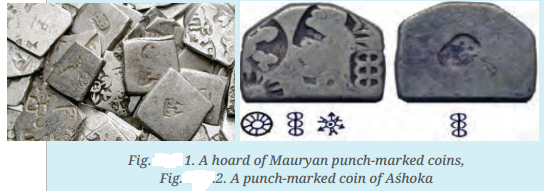
Notice the different symbols on the coins. Can you guess what any of the symbols in the coins below might mean?
Answer:
It may be very difficult to guess what any of the symbols in the coins mean but an attempt has been made below will help:
Symbol of Chakra-might mean the ‘Power’ Symbol of Tree-might mean the ‘importance of nature’
Symbols of different shapes-might mean “some natural elements’, ‘deities’ and others.
Class 7 The Rise of Empires Question Answer
Questions and Activities (Page 114)
Question 1.
What are the features of an empire, and how is it different from a kingdom? Explain.
Answer:
The features of an empire are the followings:
- Maintains army to expand an empire
- Make laws and maintain law and order
- Issues currencies
- Regulate trade
- Encourage art and literature
| Empire | Kingdom |
| 1. It is a bigger unit, comprising a collection of small kingdoms | 1. It is a single, smaller unit, a small region. |
| 2. Its ruler is called an Emperor. | 2. Its ruler is called a King/ Queen. |
| 3. Expansion of an empire takes place through wars or battles | 3. Expansion of a kingdom takes place through alliance, marriage etc. |
| 4. The cultural diversity is very high because of its size. | 4. The cultural diversities are comparatively low. |
Question 2.
What are some important factors for the transition from kingdoms to empires?
Answer:
Some important factors for the transition from kingdom to empire are the following :
- Availability of resource-rich fertile plains (Ganga plains).
- Availability of abundant forests for timber, and elephants.
- Availability of hilly regions having iron ores and other minerals.
All these factors were equally responsible for the transition from the kingdoms to empires but the use of iron with the help of technology would be the most important factor in bringing a bigger change.
Also, a clear vision of Kautilya about empires would indeed have made the empires more consolidated- economically, politically, and socially
Question 3.
Alexander is considered an important king in the history of the world —why do you think that is so?
Answer:
Alexander is considered an important king in the history of the world because of the following reasons
- He created a vast empire stretching from Greece to India by age 32.
- He spread Greek culture and ideas through conquests/wars.
- His campaign in India, though limited, opened Indo-Greek cultural exchanges, as seen in his dialogue with Gymnosophists.
- His ambition was to rule the world left a lasting legacy in history, despite his empire’s rapid division after his death.
Question 4.
In early Indian history, the Mauryas are considered important. State your reasons.
Answer:
In early Indian history, the Mauryas are considered important because of the following reasons:
- They created one of India’s largest empires.
- They unified most of the subcontinent under Chandragupta and Ashoka.
- They encouraged and strengthened trade, issuing coins and controlling routes like Uttarapatha.
- They had a long-vision ministers Kautilya and his thought to make a prosperous administration.
- They had made their kingdoms food secure.
- They had maintained and controlled the trade routes making their kingdom economically sound.
- They supported flourishing arts and cultures.
Evidence in respect of the Mauryas are considered important:
- The Sohagaura Copper Plate Inscription: Graneries establishment for food security during famines..
- Edict: Ashoka’s promotion of Buddhism and Dharma.
- Arthashastra: The text that guides to strengthening the empire economically and administratively.
Question 5.
What were some of Kautilya’s key ideas? Which ones of these can you observe even today in the world around us?
Answer:
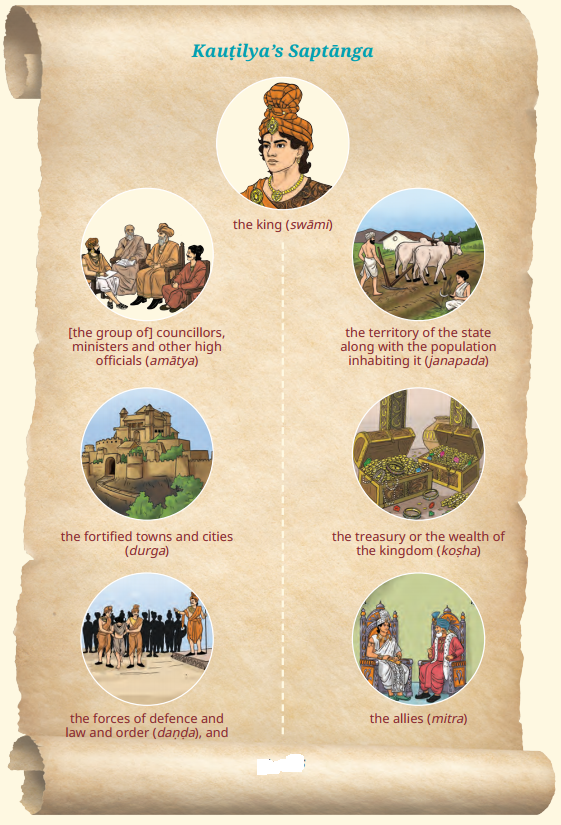
Kautilya’s key ideas were spatanga theory” that is 7 parts of the kingdom;
- Swami: The King.
- Amatya: the group of councillors, ministers and other high officials.
- Janapada: the territory of the state along with its population.
- Durga: the fortified towns and cities.
- Kosha: the treasury of the wealth of the kingdom.
- Danda: the forces of defence and law and order.
- Mitra: the allies.
We observe even today in the world around us such as the group of councillors, ministers and other high officials and the forces of defence and law and order.
Question 6.
What were the unusual things about Ashoka and his empire? What of that has continued to influence India and why? Write your opinion in about 250 words.
Answer:
The following things were unusual about Ashoka and his empire:
Unusual Things about Ashoka:
- Eagerness to expand his empire further in the beginning.
- Changes in the paths of his life after a Kalinga war.
- Adopt a path of non-violence and support overall well-being.
Unusual Things about Ashoka’s empire:
- Promote communication through edicts and inscriptions
- Encourage for the non-violence
- Encourage for environmental conservation
- Encourage for animal protection act and banned hunting.
- Support diverse religious practices.
- Adopt a policy of Dhamma
How these things influence India : The beauty and perfection of art influence India. It is because the Sarnath’s pillar’s four lions adopted as national emblem which is the symbol of unity and strength. The depiction of dharmachakra at the centre of our national flag is also unique from an Indian perspective. The motto of‘Satyameva jayate” reflects the ‘truth alone triumphs’. Ashoka’s promotion of Buddhism spread Indian culture to Sri Lanka and Southeast Asia.
His focus on tolerance inspires India’s secular ethos, encouraging respect for diverse beliefs. The Brahmi script, used in his edicts, is the ancestor of modern Indian scripts, linking India’s linguistic heritage. Ashoka’s legacy continues because his principles of peace, welfare, and ethical rule sound with India’s democratic values and continue to guide the nation’s identity and governance.
Question 7.
Thus speaks the Beloved of the Gods, the king Piyadasi: My officers of Dhamma are busy in many matters of public benefit, they are busy among members of all sects, both ascetics and householders. I have appointed some to concern themselves with the Buddhist Order, with brahmans and Ajivika..., with the Jains..., and with various sects. There are many categories of officers with a variety of duties, but my officers of Dhamma are busy with the affairs of these and other sects.
After reading the above edict of Ashoka, do you think he was tolerant towards other religious beliefs and schools of thought? Share your opinion in the classroom.
Answer:
Ashoka was open-minded towards other religious beliefs and schools of thought, as his edict shows he appointed officers of Dhamma to support all sects, including Buddhists, Brahmins, Ajivikas, Jains, and others. He ensured their welfare without favouring one group. This reflects his commitment to mutual respect and harmony among diverse beliefs.
Question 8.
The Brahmi script was a writing system that was widely used in ancient India. Try to learn more about this script, taking help from your teacher wherever required. Create a small project and include what you have learnt about Brahmi.
Answer:
The Brahmi script was a widely used writing system in ancient India. It was found in Ashokan edicts. The Brahmi was a common language of the people of that time. It was written from left to right. Most of the ancient Indian literature, inscriptions (pillars, rock pillars), and records were written in this language. This was the main language in which Buddhism was spread. It is believed that this language is the mother of many modern languages. This language became very helpful in understanding the rich culture of ancient India.
Question 9.
Suppose you had to travel from Kaushambl to Kaveripattanam, in the 3rd century BCE. How would you undertake this journey, and how long would you expect it to take, with reasonable halts on the way?
Answer:
To travel from KaushambI to Kaveripattanam in the 3rd century BCE, I would have used the Dakshinapatha trade route.
I undertook this journey on foot or ox-cart. It would have taken about 2-3 months.
I would carry food, water, and goods for trade.
The major halts at trade hubs like Ujjain and Madurai. The journey takes approximately 2-3 months.
Exploring Society India and Beyond Class 7 Solutions
More from Class 7
- Banks and the Magic of Finance Class 7 Extra Questions and Answers SST Part 2 Chapter 8
- Infrastructure: Engine of India’s Development Class 7 Extra Questions and Answers SST Part 2 Chapter 7
- The State, the Government, and You Class 7 Extra Questions and Answers SST Part 2 Chapter 6
- India, a Home to Many Class 7 Extra Questions and Answers SST Part 2 Chapter 5
- Turning Tides: 11th and 12th Centuries Class 7 Extra Questions and Answers SST Part 2 Chapter 4
- Empires and Kingdoms: 6th to 10th Centuries Class 7 Extra Questions and Answers SST Part 2 Chapter 3
More in Social Science
- Banks and the Magic of Finance Class 7 Extra Questions and Answers SST Part 2 Chapter 8
- Infrastructure: Engine of India’s Development Class 7 Extra Questions and Answers SST Part 2 Chapter 7
- The State, the Government, and You Class 7 Extra Questions and Answers SST Part 2 Chapter 6
- India, a Home to Many Class 7 Extra Questions and Answers SST Part 2 Chapter 5
- Turning Tides: 11th and 12th Centuries Class 7 Extra Questions and Answers SST Part 2 Chapter 4
- Empires and Kingdoms: 6th to 10th Centuries Class 7 Extra Questions and Answers SST Part 2 Chapter 3