The Age of Reorganisation Class 7 Question Answer SST Chapter 6
Class 7 SST Chapter 6 The Age of Reorganisation Question Answer
The Age of Reorganisation Class 7 Questions and Answers
THE BIG QUESTIONS (Page 117)
Question 1.
Why is the period that followed the Maurya empire sometimes called the ‘Age of Reorganisation’?
Answer:
The period that followed the Maurya empire is sometimes called the ‘Age of Reorganisation’ due to the following reasons:
The Emergence of New Kingdoms:
- Being the Mauryan Empire weakened and declined, new kingdoms emerged.
- These kingdoms emerged only from the earlier kingdoms or territories.
Fresh Demarcation of Kingdoms’s Boundary:
- The existing regions were reorganised.
- The boundaries of the states were demarcated frequently after the expansion of the kingdoms or empires.
Made Several Developments:
- Trade routes were re-established and expanded as needed.
- These developments witnessed economic growth.
Question 2.
What were the values or principles that guided emperors of that period?
Answer:
The values or principles that guided emperors of that period are as follows:
Revival of Vedic Rituals and practices:
- This period witnessed the revival of Vedic rituals such as Ashwamedha Yajna.
- That was indeed a big change.
- Vedic Gods like Indra, Chandra, and Surya.
Practices of Donations (dana):
- Queen’s donations were in fashion.
- Donated items- Land, cows, horses, elephants, silver coins, and some other items to priests, guests, workers, scholars, and monks.
Emphasis on Sanskrit language:
- Sanskrit became the prominent language of education.
Patronage to Scholars:
- Given aid to scholars like Patanjali, and Megasthenes.
Encouragement of art and culture:
- The art and cultures were very unique.
- That led to the development of new artistic styles.
Class 7 Social Science Chapter 6 The Age of Reorganisation Question Answer
Question 3.
How did foreign invaders assimilate into Indian society and contribute to cultural confluence?
Answer:
The foreign invaders assimilate into Indian society and contribute to cultural confluence in the following manners:
- They established a unique style of art that paved the way for development. Gandhara School of Art is a good example of it.
- They supported and adopted the Indian religion mainly Buddhism which heightened this religion beyond India.
- Many scripts witnessed a blend of linguistic traditions. During writing local languages were used with the Greek.
- They followed the same governance system and the titles that were followed by earlier kings of India.
- They adopted Indian script like Brahmi with time.
- They constructed some new roads and maintained the same roads for more economic success.
- Good communication networks.
- They developed many urban centres which later enriched the Indian culture.
Such assimilation by foreign invaders not * only enriched the Indian culture but also helped in the integration of Indian society in all respects; socially, economically, and culturally.
LET’S EXPLORE (Page 118)
Question 1.
Create a timeline on a sheet of paper marking the period from the first year of the 2nd century BCE and ending in the last year of the 3rd century CE. How many years does this period cover? As we progress through the chapter, mark the key individuals, kingdoms and events on the timeline.
Answer:
Start Period: First year of the 2nd century BCE
End Period: Last year of the 3rd Century of CE
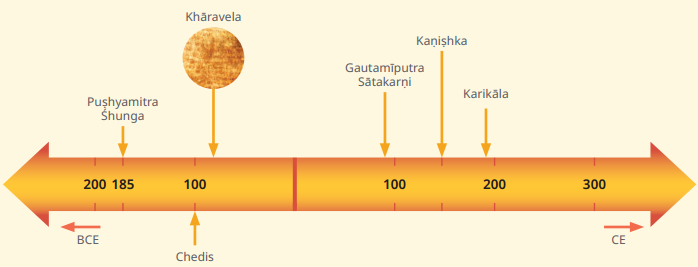
According to Timeline:
200 years (From 200 BCE to 1 BCE)
299 Years (Form 1 CE to 299 CE)
The period covers the “Total Years”:
200 + 299 = 499 years.
LET’S REMEMBER (Page 119)
Question 1.
While working on the timeline, did you notice the transition from BCE to CE? Remember what you learned in the Grade 6 chapter ‘Timeline and Sources of History’ about how time is measured in history.
Answer:
Yes, while working on the timeline, we have noticed the transition (Change) from BCE to CE.
Measurement of Time:
- Based on the birth of an important persons
- Based on the start of a ruler’s reign.
- By using various calendars such as the Gregorian calendar, Hindu, Muslim, Jewish, Chinese calendars, etc.
Time is measured in BCE (Before Common Era) and CE (Common Era).
- The years before the date of birth of Jesus are counted backward, marked as BC or BCE
- The years after the date of birth of Jesus are counted forward, marked as CE or AD
For Example:
- 1947 the year of Indian Independence is written as 1947 AD or 1947 CE.
- Similarly, the approximate year of birth of Gautama Buddha is written as 560 BCE.
LET’S EXPLORE (Page 120)
Question 1.
In the previous chapter, you studied the map o£the Maurya empire (see page 100). Above is a map of the post-Maurya period. How many kingdoms can you count in the area that were previously under the control of the Maurya empire?
Answer:
After studying the maps of the Maryan Empire and the post-Maurya period, there were the following kingdoms in the area that were previously under the control of the Mauryan Empire:
- The Shunga dynasty-In the northern parts of India
- The Satavahanas dynasty-In Deccan regions (including Maharashtra, Andhra Pradesh, Karnataka, and Madhya Pradesh)
- Indo-Greeks Kingdoms: In the northwest regions.
- The Shaka Kingdom: In the western and north-western India.
- The Kushana Empire: Cover maximum parts of north and northwest India.
- The Pandyas Kingdom: In South India
- The Chola and Chera Kingdom.
LET’S EXPLORE (Page 124)
Question 1.
Below is a panel from the Bharhut Stupa. Look at the two figures on the right. What are they doing? Can you guess their profession? Notice their attire. What does this tell us about them? List other details that you notice in the panel and discuss your findings in class.
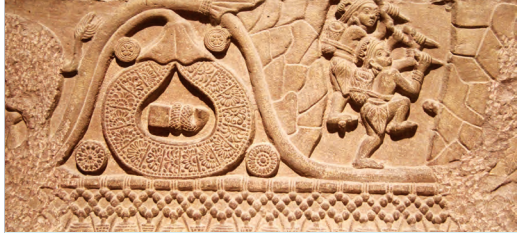
Answer:
After looking at the two figures on the right, I guess that they are engaging in artisans or sculpture. They seem to be carving and sculpting something.
After noticing their attire (dress), their attires are very simple. This indicates that they are working-class individuals.
Other details in the panel:
- The panel has complex carvings and patterns that indicate the beautiful art or craftsmanship of that time.
Question 2.
Look closely at the pictures in the collage in Fig.6.6 In a note, write down your observations on the clothes, the jewellery, and other objects of daily use.
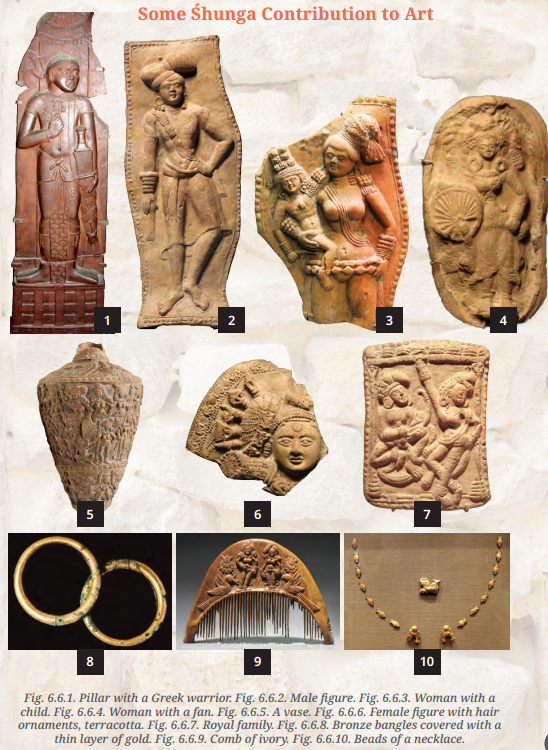
Answer:
Fig. 6.6.1. The figure is dressed as a soldier wearing armour.
Fig. 6.6.2. The figure appears to be wearing a dhoti-like cloth and a turban on the head.
Fig. 6.6.3. This figure of a woman seems to be wearing a sari or similar clothes.
Fig. 6.6.4. This figure shows a woman holding a fan. It may be a symbol of status or may be used for cooling.
Fig. 6.6.5. This figure shows a ‘Vase’. It may be pottery for daily use.
Fig. 6.6.6. This is a female figure has very fine hair ornaments.
Fig. 6.6.7. This figure shows a royal family where splendid life is shown.
Fig. 6.6.8. The figure seems to be a pair of bangles with a thin layer of gold. That shows the art of that time
Fig. 6.6.9. The figure looks like an ivory comb, used for decorative and personal care.
Fig. 6.6.10. The figure shows beads of a necklace, used for neck decoration.
Findings: The arts in the Shungas period reflect a sense of artistry and status of their period. The attire in their period was very simple. The jewellery was very simple but designed very beautifully.
THINK ABOUT IT (Page 126)
Question 1.
What, according to you, could the tradition of using the mother’s name at the beginning of a king’s name signify?
Answer:
According to us, the tradition of using the mother’s name at the beginning of a king’s name signifies the following points:
The Maternal lineage:
- It shows the dominance of the mother’s side.
- It shows the legitimacy.
The Cultural Value:
- It highlights the honour of the mother and her crucial role in the family.
The Religious Value:
- It highlights the prosperity of the society where ancestors in a society are worshiped and sought blessings.
The Social Value:
- It shows the status and influence of the mother.
In the Satavahanas tradition, Princes were often named after their mothers. Gautamiputra Satakarni was named after his mother, Gautami Balashri. This society indeed gets respect and shows the dominance of mothers.
Question 2.
In the below series of numerals, which ones look somewhat like our modern numerals? Which ones don’t?

Answer:
Symbol No. 1: It is difficult to tell exactly 1 but It looks like a modern-day dash or may be a sign of subtraction.
Symbol No. 2: It looks like a symbol, ' “equals”.
Symbol No. 4: It seems to be a cultural symbol in North Africa.
Symbol No. 6: It looks like the number ‘6’.
Symbol No. 7: It looks like the number ‘7’.
Symbol No. 9: It looks like a Syriac letter.
Symbol No. 10: It looks like the Greek letter alpha.
THINK ABOUT IT (Page 127)
Question 1.
This sculpture of a yaksha from Pitalkhora carries an inscription on its hand, kanhadasena hiramakarena kata meaning ‘made by Kanahadasa, a goldsmith’. Is it not interesting to see that a goldsmith could also craft a sculpture made of stone? What do you think this tells us about people’s professions at the time?
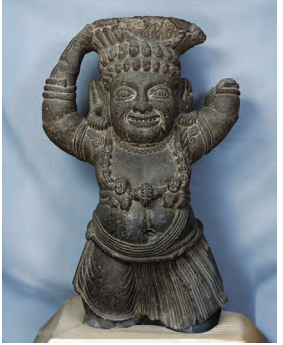
Answer:
Yes, it is very interesting to see that a goldsmith could also craft a sculpture made of stone.
This tells us how good the craftsmanship was! A goldsmith is skilled in stone carving. Marvellous!
This suggests a broader range of craftsmanship with certain professions at that time. The presence of such intricate artworks witnessed specialised professions, with individuals capable of mastering multiple crafts.
THINK ABOUT IT (Page 129)
Question 1.
Notice the regularity of the rock- cut chambers sculpted nearly two millennia ago. How did artisans achieve such precision with just a chisel and a hammer? Picture yourself as a sculptor in that era, shaping stone into art with your own hands. What tools would you use?
Answer:
The artisans achieve such precision with just a chisel and a hammer through a combination of several skills such as planning, useful modern but relevant techniques, and innovative craftsmanship.
Other details in the panel:
- Students need to try to make such sculptures.
- Students need to cut the stone in the same manner as shown in the picture they have.
Students need to use tools such as a chisel and a hammer.
Question 2.
In the map given, you may notice different symbols alongside the names of the kingdoms. What do these symbols represent? Think about how they highlight the unique identities of the kingdoms.
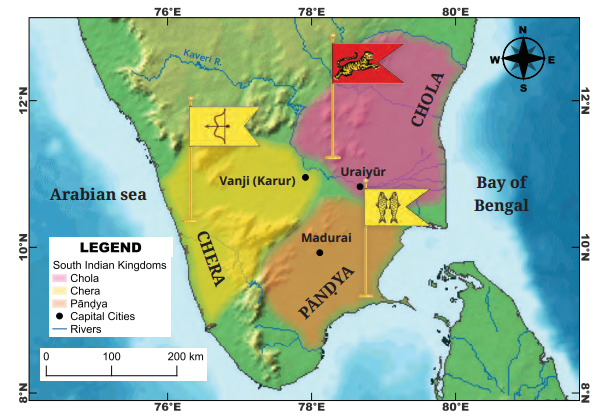
Answer:
These symbols represent the following points:
- These symbols represent royal emblems.
- The maps show the southern parts of India and the kingdoms of South India.
Emblems:
Tiger: refers to the strength of the kingdoms
which is the military power of the Chola empire.
Bow and Arrow: refers to the strategies used in the Chera kingdom.
A Pair of Fishes: refers to Pandyas’ maritime connections with other regions.
They highlight the unique identities of kingdoms by using their skills, intimate understanding of the nature of rocks, and consistent work.
THINK ABOUT IT (Page 132)
Question 1.
Observe the statue of the king. How is he depicted? What do his posture, clothing, and expression say about his power and status?
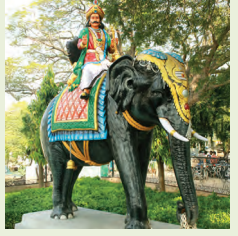
Answer:
After observing the statue of the king, he is the following things have been depicted:
- The king is riding on the elephants, suggesting the regal power of a king.
- His clothing is regal, showing the status of a king.
- The statue exhibits King Karikala as a powerful and honorable ruler.
THINK ABOUT IT (Page 133)
Question 1.
Have you ever wondered how historians uncover the trade relations between two distant kingdoms many centuries ago? Let’s take a moment to brainstorm, and discuss how this information comes to light.
Answer:
No, I never wondered because I know historians uncover the facts through archaeological findings like materials excavated, textual records, and their analyses.
- Through literary sources: The text in Tamil in Sangam Periods highlights the port cities and the trade in that period.
- Through Coins: The coins received from excavation help in understanding the trade in these kingdoms.
- Through Artefacts: As the Hathigumpha inscription and Udayagiri caves near Bhubaneswar exhibits the artefacts of that period.
THINK ABOUT IT (Page 134)
Question 1.
The Pandyas were known for their pearls. Why do you think pearls were an important article of trade during these times?
Answer:
I think pearls were an important article of trade during these times because of:
- Availability of Pearls: The Pandya kingdom is located close to the Gulf of Mannar, rich in pearl oysters.
- Quality of Pearls: The pearl found in this region is highly lustered. Therefore, the demand for the peals was very high in other regions.
- Cultural and Religious Values: The pearl was considered sacred. These were used for worship and adorned deities.
- Economic Value: The trade of pearls brought prosperity to the economy of Pandya’s kingdom.
LET’S EXPLORE (Page 135)
Question 1.
What do you think might have been the meaning of having deities like Vasudeva-Krishna or Lakshml on some Indo-Greek coins?
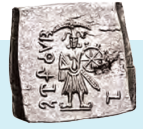
Answer:
I think might have been the meaning of having deities like Vasudeva-Krishna or Lakshmi on some Indo-Greek coins as follows:
- Intermixture of Religion: The coins depict the fusion of two religions; the Greek and the Indian.
- Honour to Indian deities: The coin shows that the Greeks gave respect to the Indian deities. The coins exhibit that the Greeks adopted Indian deities.
- Influence of the Culture: Such kind of blend of Greek and Indian influenced the culture of the nation.
LET’S EXPLORE (Page 136)
Question 1.
Carefully observe this massive statue (1.85 m high) and notice the clothing, weapon, and footwear. What does it tell us about this figure?
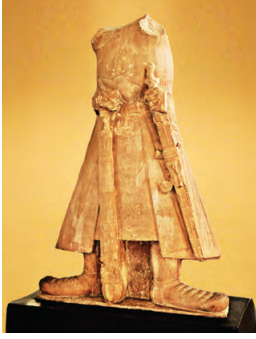
Answer:
Observing this massive statue, the following things tell us about this figurine:
- Clothing: It seems a long heavy coat, an early form of Sherwani. This attire used to be in Central Asia.
- Weapons: The swords and the mace symbolize the power of a king.
- Footwear: The boots as footwear show that he used to be involved in various campaigns like military and other administrative.
Question 2.
Observe the coins carefully. Who, besides the emperor, appears on the coin?
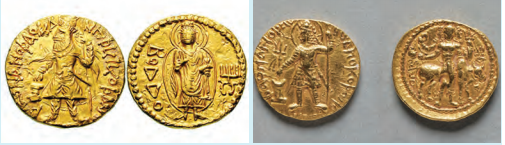
Answer:
The 'Buddha, besides the emperor, appears on the coins of Kanishka, a ruler of the Kushan dynasty. On the other coin, the emperor appears on one side, and the Shiva with the bull Nandi on the other.
CHAPTER QUESTION (Page 137)
Question 1.
Why would a powerful ruler feature Buddha and Shiva on his coins? What does it say about his values and priorities?
Answer:
A powerful ruler would feature Buddha and Shiva on his coins because:
- He ants people could respect every religion with their choice.
- He wants to unify the various communities.
- He wants to spread multi-cultural aspects in the region.
He says the following points about his value and prosperity:
- The nation should be empowered.
- People must maintain discipline, following different religions.
Question 2.
Can you find modern examples of such symbolic currency?
Answer:
Modern examples:
- In 2012, the Indian Government issued coins of Rs. 5 and Rs. 10 figuring Mata Vaishno Devi on them.
- Bhutani Coins have a wheel of Dharma on a lotus.
THINK ABOUT IT (Page 137)
Question 1.
Do you know where Gandhara is? Does it remind you of a character from the epic Mahabharata?
Answer:
Yes, we know.
- Gandhara is located in Pakistan and Afghanistan in the present day..
Character from the epic Mahabharata:
Gandhari: Daughter of King Subla of the Gandhara Kingdom and wife of Dhritrashtra.
LET’S EXPLORE (Page 140)
Question 1.
Now that you are familiar with the basic characteristics of the Mathura and Gandhara styles of art, study the pictures of artefacts given in Fig. 6.27 on the right page and try to identify which school of art each artefact belongs to. Write your observations with justifications and discuss your answers with your classmates.
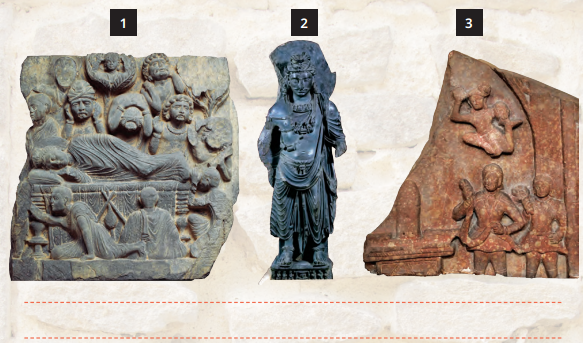
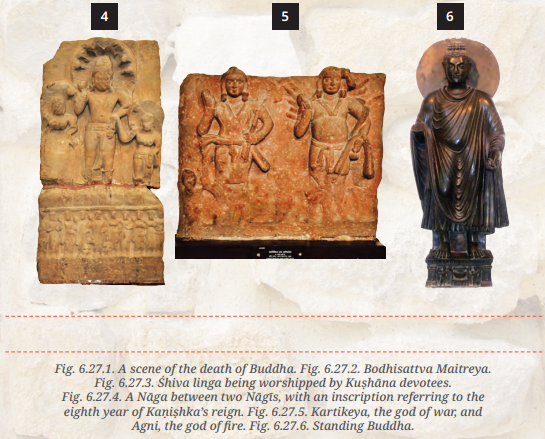
Answer:
Fig. 6.27.1. This is the Gandhara School of Art.
Fig. 6.27.2. This is the Mathura School of Art.
Fig. 6.27.3. This is the Mathura School of Art.
Fig. 6.27.4. This is the Mathura School of Art.
Fig. 6.27.5. This is the Mathura School of Art.
Fig. 6.27.6. This may be a blend of the Gandhara and Mathura School of Art.
Observations with justification:
- ‘Gandhara School of Art’ has its significance which shows the various scenes from the life of Buddha.
- ‘Mathura School of Art’ depicts the Indian deities along with the Buddhist figure.
Class 7 The Age of Reorganisation Question Answer
Questions and Activities (Page 143)
Question 1.
Why was the post-Maurya era also known as the era of reorganisation?
Answer:
The post-Maurya era was called the Age of Reorganisation because:
The Emergence of New Kingdoms:
- Being the Mauryan Empire weakened and declined, new kingdoms emerged.
- These kingdoms emerged only from the earlier kingdoms or territories.
Fresh Demarcation of Kingdoms’s Boundary:
- The existing regions were reorganised.
- The boundaries of the states were demarcated frequently after the expansioji of the kingdoms or empires.
Made Several Developments:
- Trade routes were re-established am expanded as needed.
- These developments witnessed economic growth.
Question 2.
Write a note on the Sangam literature in 150 words.
Answer:
Sangam literature is the oldest in South India. This was the collective work of many poets. The work done by the poets was so unique in all aspects that no one can define it in words. Consequently, this period was known as the Sangam age. Here, Sangam means the assembly of poets and scholars.
The literature focuses on the social aspects in which people in society are engaged in various occupations such as agriculture, art,
and trade. The literature is good for political perspectives. It tells about good governance and other political aspects. It also focuses on the trade and trade routes of the kingdoms.
Question 3.
Which rulers mentioned in this chapter included their mother’s name in their title, and why did they do so?
Answer:
Gautamipurtra Satakarni: They did so because:
- It shows the dominance of the mother’s side.
- It shows the legitimacy.
- It highlights the honour of the mother and her crucial role in the family.
- It highlights the prosperity of the society where ancestors in a society are worshiped and sought blessings.
- It shows the status and influence of the mother.
Question 4.
Write a note of 250 words about one kingdom from this chapter that you find interesting. Explain why you chose it. After presenting your note in class, find out what kingdoms have been the most selected by your classmates.
Answer:
A Note on the Satavahanas Kingdom
I found the Satavahana kingdom very interesting because the kingdoms had some unique features such as economic and cultural prosperity. The period of this kingdom is from the 2nd century BCE to the 3rd century CE and covers almost Andhra Pradesh, Telangana, and Maharashtra.
I chose it because this period has the most attractive feature which is that,” Princes were often named after their mother as in the case of Gautamiputra Satakarni. The tasks of women were commendable. They had a right to do the task of their choice.
The Satavahanas were devout followers of Vasudeva and supporters of other schools of thought, which flourished during their rule. Here Kings had granted tax-free land to Vedic scholars, jaina and Buddhist monks, helping them to pursue their practices.
Krishna-Godavari river system flourished the agricultural system in the regions of the Satavahanas. That would have given economic stability to the kingdom. This stability opened the door for doing other acts like trade.
They were peace-loving. This can be said because very limited evidence is available that they were involved in warfare activities. They had fully focused on growing the economy of their kingdom. For this, they issued coins, bearing the image of a seafaring ship with two masts.
That shows that they were involved in maritime trade and had advanced technology in shipbuilding and navigation.
In essence, the Satavahanas dynasty was supreme in my point of view because of their arts and cultures can be noticed in the kingdom and efficient networks of trade and advanced technologies also made the kingdom sound.
Question 5.
Imagine you have the chance to create your own kingdom. What royal emblem would you choose, and why? What title would you take as the ruler? Write a note about your kingdom, including its values, rules and regulations, and some unique features.
Answer:
I named my kingdom-“Samarpan,”
Chosen Royal Emblem: A Lotus Title as a ruler: “Dharmaraja,”
Note: First I would like to thank my subjects and work for their welfare. I emphasise ethical rules. I promote all the values which are essential for the progress of a nation such as quality of education, Health sectors, environmental issues, etc.
I appeal to everyone to support the nation by taking active participation and trying to make a council for the defaulters. I support all religions and other schools of thought and give freedom to all to adopt the religion of their choice.
I try to improve the technologies for the more progress of the nation, and also maintain and improve the economic activities and improve the communication with neighbours. I focus on other artisan tasks and agriculture in my areas so that economic prosperity can be brought.
I would try to make a nation that would be an example in the whole universe where people respect each other and cooperate without any discrimination and put down their skills to the forthcoming generation so that they can continue the culture with some changes with time and need.
Question 6.
You have read about the architectural developments of the post-Maurya era. Take an outline of the Indian subcontinent and mark the approximate locations of some of the ancient structures mentioned in this chapter.
Answer:
The post-Maurya era was full of architectural development Such as:
Architectural Structures | Locations |
The beautiful railings | Bharhut Stupa, Madhya Pradesh |
The Hathigumpha Inscriptions | Udayagiri-Khanda- giri Caves, near Bhubaneswar |
A Yaksha | Pitalkhora Caves, Maharashtra |
Major Trade routes near for collection of tolls and taxes and resting places for traders. | Naneghat Caves, near Pune |
Magnificent pillars and a stone replica of the Stupa in the centre | Karla Caves, near Lonavala, Maharashtra |
The art rock-cut and stupa structures spread across central, western, and eastern India. It reflects the era of artistic and religious diversity and a blend of Indian and foreign influences. This is indeed the beauty of this era.
Exploring Society India and Beyond Class 7 Solutions
More from Class 7
- Banks and the Magic of Finance Class 7 Extra Questions and Answers SST Part 2 Chapter 8
- Infrastructure: Engine of India’s Development Class 7 Extra Questions and Answers SST Part 2 Chapter 7
- The State, the Government, and You Class 7 Extra Questions and Answers SST Part 2 Chapter 6
- India, a Home to Many Class 7 Extra Questions and Answers SST Part 2 Chapter 5
- Turning Tides: 11th and 12th Centuries Class 7 Extra Questions and Answers SST Part 2 Chapter 4
- Empires and Kingdoms: 6th to 10th Centuries Class 7 Extra Questions and Answers SST Part 2 Chapter 3
More in Social Science
- Banks and the Magic of Finance Class 7 Extra Questions and Answers SST Part 2 Chapter 8
- Infrastructure: Engine of India’s Development Class 7 Extra Questions and Answers SST Part 2 Chapter 7
- The State, the Government, and You Class 7 Extra Questions and Answers SST Part 2 Chapter 6
- India, a Home to Many Class 7 Extra Questions and Answers SST Part 2 Chapter 5
- Turning Tides: 11th and 12th Centuries Class 7 Extra Questions and Answers SST Part 2 Chapter 4
- Empires and Kingdoms: 6th to 10th Centuries Class 7 Extra Questions and Answers SST Part 2 Chapter 3