New Beginnings Cities and States Class 7 Question Answer SST Chapter 4
Class 7 SST Chapter 4 New Beginnings Cities and States Question Answer
New Beginnings Cities and States Class 7 Questions and Answers
THE BIG QUESTIONS (Page 67)
Question 1.
What is meant by ‘Second Urbanisation of India’?
Answer:
‘Second Urbanisation’ of India means a new phase in the history of India during which the emergence of new urbanisation took place with the help of a shift in technology involving iron metallurgy.
Indeed ‘Second Urbanisation’ may be called a period of historical developments in India with the rise of new kingdoms, agricultural advancement, Improvement in the quality of tools etc.
Question 2.
Why were the janapadas and mahajanapadas an important development in India’s early history?
Answer:
The janapadas and mahajanpadas were important in India’s early history because of the following reasons:
- Innovation in Technologies
- Advancement in Agriculture
- Rise of various kingdoms
- Rise of trade centres
- Introduction of coins
- Development in economies
Class 7 Social Science Chapter 4 New Beginnings Cities and States Question Answer
Question 3.
What kind of system of governance did they evolve?
Answer:
They evolve the following kind of system of governance:
Monarchical System
In the beginning, the monarchical system of government was noticed. Such as
- Single king
- Hereditary Rule
- Centralised power Ganarajyas (Republican) system Later, Ganarajyas (Republics) came into existence in the powerful mahajanpadas. Such as
- Power vested in assemblies or councils
- Collective decision-making among members
THINK ABOUT IT (Page 70)
Question 1.
Notice how many of the mahajanapadas are concentrated in the Ganga plains. There are several possible reasons for this, including the growth of agriculture in the fertile
Ganga plains, the availability of iron ore in the mountains and hills (see below about iron), and the formation of new trade networks.
Answer:
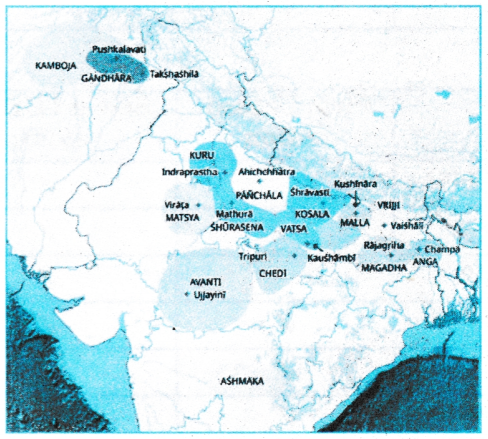
Many of the mahajanapadas are concentrated in the Ganga plains-Kosala, Magadha, Vrijji, Malla, Kashi and Anga.
Reasons
- Availability of fertile lands
- Availability of iron ore
- Formation of new trade networks.
LET'S EXPLORE (Page 70)
Question 1.
The most powerful of these new states were Magadha, Kosala, Vatsa and Avanti. Looking at the map, can you identify their capitals? Also, how many can you match with Indian cities of today?
Answer:
| New States | Capitals |
| Magadha | Raj agriha |
| Kosala | Shravasti |
| Vatsa | Kaushambi |
| A v anti | Ujjayini |
Magadha: Rajgir (Bihar)
Kosala: in today’s Ayodhya (Uttar Pradesh)
Vatsa: in today’s Prayagraj (Uttar Pradesh)
Avnati: in today’s Ujjain (Madhya Pradesh)
Question 2.
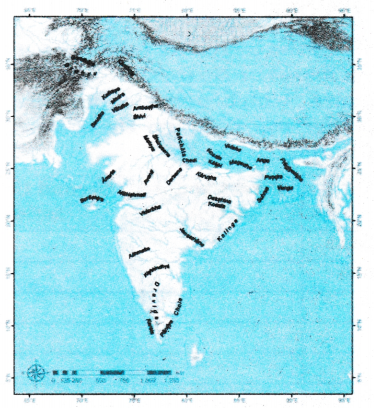
Compare this map with the map of the regions mentioned in the Mahabharata (see Fig.in the chapter ’India, That Is Bharat’ in Grade 6) and list the names common to both maps. What do you think this implies?
Answer:
List of Names of Regions Common to Both Maps:
| Regions | Regions Listed In The Mahabharata | Regions Listed In The Mahajanapadas |
| Panchala | ✓ | ✓ |
| Magadha | ✓ | ✓ |
| Kosala | ✓ | ✓ |
| Matsya | ✓ | ✓ |
| Anga | ✓ | ✓ |
| Gandhara | ✓ | ✓ |
| Avanti | ✓ | ✓ |
LET’S EXPLORE (Page 74)
Question1.
Fill up the following table with a Yes (or tick mark) or No (or cross mark) in each square, which provides an interesting comparison between these two phases of Indian civilisation.
| First Urbanisation | Second Urbanisation | |
| Ganga Plains | ||
| Monasteries | ||
| Literature | ||
| Trade | ||
| Warfare | ||
| Copper/bronze | ||
| Iron |
Answer:
| First Urbanisation | Second Urbanisation | |
| Ganga Plains | ✓ | |
| Monasteries | ✓ | |
| Literature | ✓ | |
| Trade | ✓ | ✓ |
| Warfare | ✓ | ✓ |
| Copper/bronze | ✓ | ✓ |
| Iron | ✓ |
LET’S EXPLORE (Page 76)
Question 1.
Why should a complex society divide itself into such groups? Think about several possible factors why this happens.
Answer:
Factors are the following :
- Based on occupations
- Inequality in society
- Diversity in cultures like religions, languages, customs, traditions, etc.
Question 2.
List other such professions you expect in a complex society of the 1st millennium BCE.
Answer:
A List of other such professions of the 1st millennium BCE is as follows:
Purohita, Acharya, Senani, Gramani, Krishaka, Gopala, Manikarna, Karmara, etc.
THINK ABOUT IT (Page 78)
Question 1.
Inequalities within society can exist in many forms. Have you encountered any incident where you or anyone you know might have been made to feel different from others? Do you think equality is desirable in a society? If so, why? Have you come across people or initiatives that lessened inequalities?
Answer:
Yes, I have encountered an incident when I knew might have been made to feel different from the others.
Yes, equality is not only desirable but it should be essential for a successful society.
It is so for the following reasons:
- For social unity.
- For economic growth
- For welfare activity
- To remove discrimination.
Yes, I have come across a person Mr Rajeev who runs an NGO and works on inequalities such as discrimination of caste.
Class 7 New Beginnings Cities and States Question Answer
Questions and Activites (Page 81)
Question 1.
Consider the quotation at the start of the chapter and discuss in several groups. Compare your observations and conclusions on what Kautilya recommends for a kingdom. Is it very different today?
Answer:
Kingdom is well-protected:
A well-protected kingdom provides a safe atmosphere for people and may be good for prosperity. It is possible only when its capital and towns are fortified.
Kingdom should be capable and supporting:
The land in the kingdom should be capable and supportive not only of its citizens but should be very supportive to outsiders in case of emergency.
Kingdom should be beautiful:
The areas in the kingdom should be beautiful, enriched with cultivable land, mines, forests and pasture land as well.
Kingdom should have proper water resources and its utilisation system:
The areas in the kingdom should have proper water resources for many other purposes. In simple words, the kingdom should not depend only on the rain for water.
Kingdom should have a productive economy:
The kingdom’s economy should be prosperous so that citizens get ample opportunity.
That is also good for the kingdom as well.
To find the answer to ‘yes’ or ‘no’ will not be fine. Because these recommendations for a region may not be correct.
In effect, the physical features of a region don’t allow all these recommendations at the same place.
Yes, it may be very different today.
Question 2.
According to the text, how were rulers chosen in early Vedic society?
Answer:
According to the text, rulers were chosen in early Vedic society in a manner which is mentioned below :
- Chosen by assemblies such as Sabha and Samiti
- Chosen on the basis of the competency of a person
- Chosen on the basis of a person’s inclination towards the well-being
Question 3.
Imagine you are a historian studying ancient India. What types of sources (archaeological, literary, etc.) would you use to learn more about the mahajanapadas1! Explain how each source might contribute to your understanding.
Answer:
Imagined I am a historian studying ancient India. The following types of resources I would use to learn more about the mahajanapadas: Archaeological Sources:
It helps in understanding the crafting, agricultural activities and military organisation.
Literary Sources:
It helps in understanding the society, religious practices and orders of the kings in each mahajanapadas and its capital etc.
Coins:
It helps in understanding the trade with other kingdoms or outside of nations and the economic status of kingdoms.
Question 4.
Why was the development of iron metallurgy so important for the growth of urbanism in the 1st millennium BCE? You may use points from the chapter but also from your knowledge or imagination.
Answer:
The development of iron metallurgy was so important for the growth of urbanism in the 1st millennium BCE because:
- It brought a change in agriculture on a bigger scale
- It improved the quality of weapons
- It brought economic prosperity
- It made the kingdoms powerful
Exploring Society India and Beyond Class 7 Solutions
More from Class 7
- Banks and the Magic of Finance Class 7 Extra Questions and Answers SST Part 2 Chapter 8
- Infrastructure: Engine of India’s Development Class 7 Extra Questions and Answers SST Part 2 Chapter 7
- The State, the Government, and You Class 7 Extra Questions and Answers SST Part 2 Chapter 6
- India, a Home to Many Class 7 Extra Questions and Answers SST Part 2 Chapter 5
- Turning Tides: 11th and 12th Centuries Class 7 Extra Questions and Answers SST Part 2 Chapter 4
- Empires and Kingdoms: 6th to 10th Centuries Class 7 Extra Questions and Answers SST Part 2 Chapter 3
More in Social Science
- Banks and the Magic of Finance Class 7 Extra Questions and Answers SST Part 2 Chapter 8
- Infrastructure: Engine of India’s Development Class 7 Extra Questions and Answers SST Part 2 Chapter 7
- The State, the Government, and You Class 7 Extra Questions and Answers SST Part 2 Chapter 6
- India, a Home to Many Class 7 Extra Questions and Answers SST Part 2 Chapter 5
- Turning Tides: 11th and 12th Centuries Class 7 Extra Questions and Answers SST Part 2 Chapter 4
- Empires and Kingdoms: 6th to 10th Centuries Class 7 Extra Questions and Answers SST Part 2 Chapter 3