India A Home to Many Class 7 Question Answer SST Part 2 Chapter 5
India A Home to Many Class 7 Questions and Answers
Class 7 SST Part 2 Chapter 5 Question Answer
The Big Questions (Page 125)
Question 1.
What has made India a home for people from different parts of the world?
Answer:
India became a home for people worldwide due to its ancient history of welcoming diverse cultures through traders and scholars, its deep-rooted traditions of tolerance and acceptance (welcoming Jews, hosting diverse faiths), vast cultural diversity fostering a ‘live and let live’ spirit, and its historical role as a crossroads for trade, ideas, and peoples, making it a complex yet integrated “mosaic” rather than a melting pot. India’s long history as a complex, ancient civilization with inherent diversity and a tradition of welcoming others, combined with modern economic factors, has made it a unique home for people from across the globe.
Question 2.
Why did oppressed or persecuted people from other countries seek refuge in India?
Answer:
Oppressed or persecuted people seek refuge in India due to its long history of offering sanctuary, geographic proximity to conflict zones (like Tibet, Sri Lanka, Myanmar, Afghanistan), cultural links, perceived secular/tolerant environment (despite recent shifts), and humanitarian tradition, providing a safe haven from persecution based on religion, politics, or ethnicity, as seen with Tibetans, Sri Lankan Tamils, and others.
Class 7 Social Science Part 2 Chapter 5 Question Answer
Question 3.
What is it about the nature of Indian society that enables people to assimilate here?
Answer:
Indian society is institutionalized in nature in the form of well developed systems like Family, Marriage, Gotra and Caste System Indian society is a multi-class due to several classes exists in India. This classification is based ones birth as well as his achievements.
Let’s Explore
Question 1.
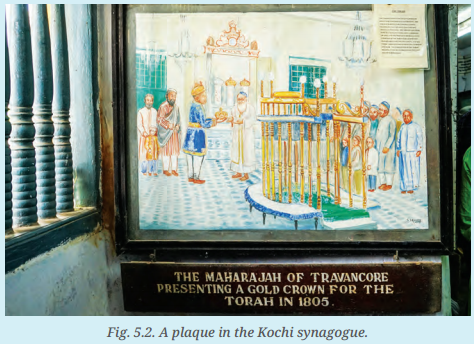
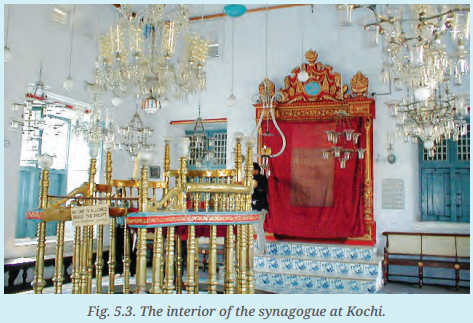
Look at the two pictures below. Is the place shown in both the photographs the same? Why is the Maharaja of Travancore (the name of the kingdom in and around Kochi at that time) giving such an expensive gift to the Jewish synagogue for the Torah (religious book of the Jews)? (Page 128)
Answer:
Yes, both photographs are of the same place, the Paradesi Synagogue in the Jew Town area of Kochi, Kerala. The Maharaja of Travancore gave valuable gifts to the synagogue, including a gold crown in 1805 and silver lamps, as a symbol of the peaceful coexistence and mutual respect. It shows kindness and religious tolerance of Indian rulers, also proves that Jews lived peacefully and freely in India.
Question 2.
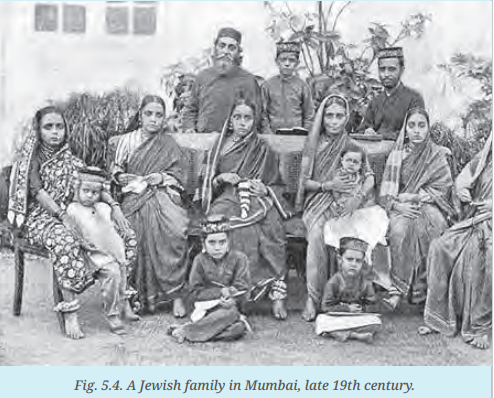
Observe the picture. What clues do you get about the integration of the Jewish community into Indian society over time? (Page 129)
Answer:
The picture in the context of the Jewish community in India likely shows a synagogue with architecture that blends traditional Jewish design with local Indian styles, such as the Paradesi Synagogue in Kochi. The clues from such a picture that indicate the integration of the Jewish community into Indian society over time include.
This fusion of styles indicates a harmonious coexistence and cultural exchange with the surrounding Indian society.
Question 3.
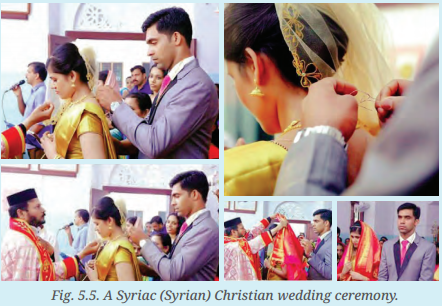
Observe the pictures below. What are the clues you get about the integration of the Syriac Christian community into Indian society? (Page 130)
Answer:
The images of a Syriac Christian wedding ceremony provide several visual clues about the community’s deep cultural integration with mainstream Indian (specifically Keralite Hindu) society, while still maintaining its distinct Christian faith. In essence, these images illustrate a blend of Christian rites (like the church ceremony and blessings) with a strong foundation of local, pre-existing Keralite customs, showcasing a unique “Indian in Culture, Christian in Religion”.
Question 4.
This painting of a ‘ Parsi bride getting ready for her wedding shows many aspects of , Indian culture. Do any of them seem familiar to you? Based on what you see, can you draw any conclusions about the integration of Parsi culture in India? (Page 132)
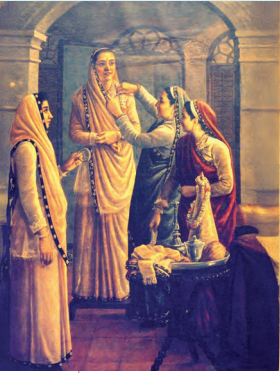
Fig. 5.7. Decking the Bride, a painting by Raja Ravi Varma
Answer:
Yes, several aspects in the painting seem . familiar, like the bride is wearing Indian jewellery, dress and makeup. The wedding rituals also look similar to Indian ceremonies. This shows that Parsis adopted many Indian traditions. It proves that Parsi culture is well integrated into Indian society.
Question 5.
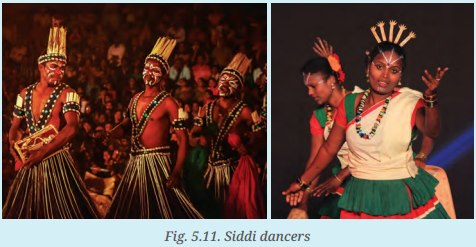
What clues do you get about African and Indian cultural integration from the pictures here and above? Identify and name a few features that are distinctly Indian. (Page 134)
Answer:
The picture shows a clear blending of African and Indian culture. The Siddis wear Indian- style clothes and ornaments, and have a distinctive dance accompanied by African- style drumming. While their attire like peacock feathers and face paint shows typical Indian style clothing.
Question 6.
Are there communities in your neighbourhood whose ancestors might have come to India centuries ago and made it their home? Have a class discussion on what their experience may have been. (Page 140)
Answer:
Yes, many communities across India have ancestors who migrated centuries ago, blending their unique cultures into India’s diverse fabric. While retaining some traditions, these communities adopted local languages, clothing, and food, blending into the existing society. Early settlers likely faced immense hardships, including language barriers, adapting to a new climate, and navigating different social structures.These communities have added to India’s rich diversity.
Question 7.
Identify similar values in any story or local tradition etc. known to you. You could ask your guardians or relatives too. Collect these stories and create a class manuscript. You could include illustrations. (Page 140)
Answer:
Hints: Local tradition is the custom of Langar in Sikhism. This shows values of equality, sharing, kindness and caring for all.
Think About It
Question 1.
Imagine this scenario—A stranger knocks at your door at midnight. It is raining heavily outside, and the stranger seeks shelter for the night claiming that his car broke down while he was driving in the vicinity. Your family goes into a huddle to discuss the pros and cons of letting a stranger into the house at night. Form two groups to discuss the arguments for and against in this scenario.
Now extend this scenario to a country like India — when refugees seek shelter in India, will similar arguments apply?
(Page 126)
Answer:
If a stranger knock at our door at midnight during heavy rain, our family may debate whether to let him in or not.
On one hand, helping someone in distress shows kindness and humanity, but on the other hand, there are concerns about safety and trust.
In the same way, when refugees seek shelter in India, similar arguments arise. Welcoming them reflects compassion, cultural values, and the spirit of Vasudhaiva Kutumbakam— the world is one family—yet challenges such as security, resources and adjustment must also be considered.
Thus, both at the level of a family and a nation, decisions about giving shelter involve balancing humanity with caution.
Question 2.
What do you think dissolving the sugar ‘in the milk without spilling it meant? (Page 131)
Answer:
Dissolving the sugar in the milk without spilling it” suggests blending something sweet and valuable into life or society quietly and carefully, without waste or harm.
Class 7 India A Home to Many Question Answer
Questions and Activities (Page 142)
Question 1.
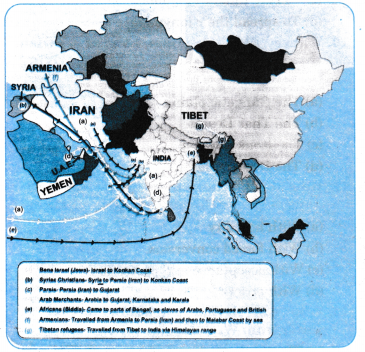
On the outline of a world map, try to trace the routes that the communities mentioned in this chapter may have used to reach India. What types of physical geographies did they have to negotiate?
Answer:
The physical geographies such as high mountains, vast deserts, dense forests, wide river, plains and coastal areas may they have used to reach India.
Question 2.
What are the key values intrinsic to Indian culture that enable it to welcome people of different backgrounds?
Answer:
The intrinsic values with in Indian culture that enable it to welcome people of different backgrounds stem from its ancient philosophical, social, and ethical principles, which emphasize interconnectedness, respect for diversity, and universal compassion.
Key values include:
- Vasudhaiva Kutumbakam (“The World is One Family”):
- Atithi Devo Bhava (“The Guest is God”): These core values collectively form an inclusive framework that enables Indian society to embrace people from diverse backgrounds, fostering a sense of belonging and shared humanity.
Question 3.
Homi Bhabha, Sam Maneck^haw, Ratan Tata, Fali Nariman, Nani Palkivala, and Cornelia Sorabji are a few names of Parsis who excelled in their respective fields. Find out more about people from other communities xthat made India their home and their contributions.
Answer:
India has been a welcoming home to people from many diverse communities who have significantly enriched its history and progress. Beyond the Parsi community, here are some notable individuals from other backgrounds who have made lasting contributions:
- Mother Teresa (Albanian origin) - Served the poor in India.
- Dalai Lama (Tibetan) - Promoted peace and compassion worldwide.
- Annie Besant (British) - Freedom fighter and educationist.
- Sister Nivedita (Ireland) — A disciple of Swami Vivekanand, she worked for women’s education and social upliftment in India.
Question 4.
Take up a class project. Divide the class into groups. Each group takes up a small project to study a little more about the communities that we have been listed here. Share what you have gathered with your classmates through one of these ways — drama, posters, song, painting, etc.
Answer:
(Suggested answer) One group can study the Parsi community and find out about their migration from Persia to India. They can also learn about their peaceful settlement in Gujarat. Their contributions to industry, education and social service can be studied. The project can be presented through a poster, chart or role-play in the class.
Exploring Society India and Beyond Class 7 Solutions
More from Class 7
- Banks and the Magic of Finance Class 7 Extra Questions and Answers SST Part 2 Chapter 8
- Infrastructure: Engine of India’s Development Class 7 Extra Questions and Answers SST Part 2 Chapter 7
- The State, the Government, and You Class 7 Extra Questions and Answers SST Part 2 Chapter 6
- India, a Home to Many Class 7 Extra Questions and Answers SST Part 2 Chapter 5
- Turning Tides: 11th and 12th Centuries Class 7 Extra Questions and Answers SST Part 2 Chapter 4
- Empires and Kingdoms: 6th to 10th Centuries Class 7 Extra Questions and Answers SST Part 2 Chapter 3
More in Social Science
- Banks and the Magic of Finance Class 7 Extra Questions and Answers SST Part 2 Chapter 8
- Infrastructure: Engine of India’s Development Class 7 Extra Questions and Answers SST Part 2 Chapter 7
- The State, the Government, and You Class 7 Extra Questions and Answers SST Part 2 Chapter 6
- India, a Home to Many Class 7 Extra Questions and Answers SST Part 2 Chapter 5
- Turning Tides: 11th and 12th Centuries Class 7 Extra Questions and Answers SST Part 2 Chapter 4
- Empires and Kingdoms: 6th to 10th Centuries Class 7 Extra Questions and Answers SST Part 2 Chapter 3